
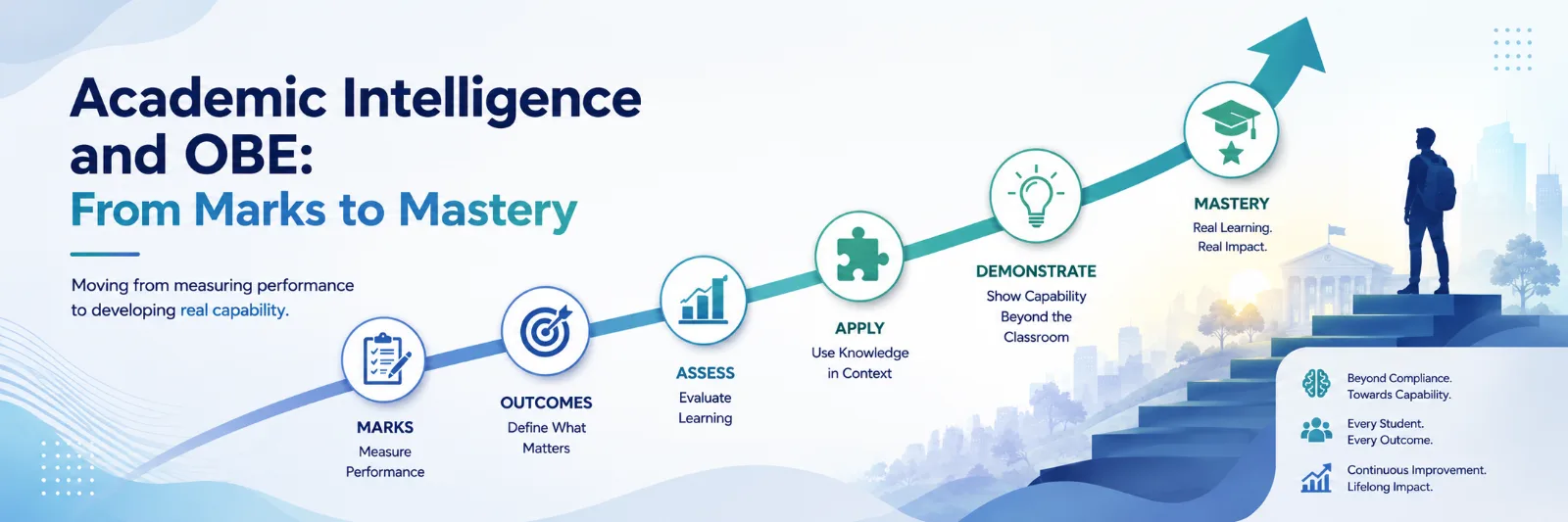
Academic Intelligence and OBE: From Marks to Mastery
By Studium Tech Pvt Ltd · 24 Aug 2026 · 48 views · edited 24 Aug 2026
Do Accreditation Documents Really Prove That Students Are Learning?
Higher education has become increasingly sophisticated at documenting the teaching process.
Course outlines are mapped. Rubrics are prepared. Attendance is recorded. Assessments are documented. Course Outcomes and Program Outcomes are aligned. Reports are compiled for accreditation and quality assurance.
But documentation of the educational process does not necessarily demonstrate its result.
The more important question is:
Can an institution demonstrate what its students are actually capable of doing?
This distinction sits at the heart of Outcome-Based Education (OBE).
As higher education prepares students for a world shaped by artificial intelligence, rapidly changing industries and increasingly complex professional challenges, the ability to demonstrate capability matters more than the ability to simply achieve a score.
The challenge, therefore, is not to produce more evidence of teaching.
It is to produce stronger evidence of learning.
The Problem with Treating Outcome Attainment as a Threshold
In many institutions, Course Outcome attainment can become heavily dependent on predefined numerical thresholds.
For example, an institution may establish a benchmark in which a certain percentage of students must achieve a particular mark for an outcome to be considered attained.
On paper, this creates a measurable system.
But measurement does not automatically equal meaningful assessment.
A student who crosses a predefined threshold may be recorded as having achieved the outcome, but the threshold does not necessarily reveal how well the student can apply the underlying capability.
This creates several problems.
Thresholds Do Not Equal Mastery
A threshold tells us how many students crossed a line.
It does not necessarily tell us how deeply they understand the concept or whether they can apply it beyond the assessment in which it was measured.
A Single Outcome Can Hide Significant Differences
Two students may both technically meet the same Course Outcome while demonstrating very different levels of understanding.
One may have barely crossed the required threshold.
Another may demonstrate sophisticated understanding and application.
Treating both as equivalent attainment can conceal important differences in learning.
The Students Below the Threshold Disappear
Aggregated attainment figures can also hide the students who have not achieved the expected outcome.
More importantly, they may fail to answer the diagnostic questions that matter most:
What exactly did these students struggle with?
Which part of the capability remains undeveloped?
What additional learning opportunity would help them progress?
And there is another question that is often overlooked:
Are high-performing students being given opportunities to move beyond basic attainment towards advanced capability?
A meaningful outcome-based system should answer all of these questions.
Learning Is Not the Same as Performance
One of the most important distinctions in assessment is the difference between performance and learning.
An examination measures performance in a particular environment.
A student receives a question, works within a defined period and produces a response according to the expectations of the assessment.
But learning goes further.
Learning becomes meaningful when a student can transfer a capability to a new context.
That means the student can take something learned in one environment and use it when the circumstances, problem or application changes.
This transfer can be observed through several dimensions.
1. Contextual Application
Can the student apply a concept to an unfamiliar or real-world problem rather than reproduce a familiar answer?
2. Development Over Time
How does the student's capability develop between the beginning and end of the programme?
3. Demonstration Beyond the Classroom
Can the student apply knowledge during internships, projects, fieldwork, research or community engagement where there is no predetermined answer?
These forms of evidence provide a richer picture of learning than a single examination score.
The Pilot Test: Would You Certify Capability Without Demonstration?
Consider the example of a pilot.
A pilot is not considered competent simply because they have answered enough questions correctly on a written examination.
Competence must ultimately be demonstrated.
The individual must be able to perform the required tasks, respond to changing conditions and apply their knowledge in practice.
The same principle can be applied to higher education.
If a student graduates in business strategy, can they actually analyse a business problem?
If a student graduates in engineering, can they apply engineering principles to an unfamiliar problem?
If a student graduates in design, can they create and justify an appropriate solution?
If the answer is yes, the institution has evidence of capability.
This is the fundamental shift from assessment of recall to assessment of demonstrated competence.
From Marks to Levels of Proficiency
Moving beyond traditional marks does not mean abandoning measurement.
It means making measurement more meaningful.
Instead of treating learning as a binary question—achieved or not achieved—institutions can evaluate different levels of proficiency.
A simple model could distinguish between:
- Level 0: Capability has not yet been demonstrated.
- Level 1: Capability has been demonstrated partially.
- Level 2: Capability has been demonstrated at a moderate level.
- Level 3: Capability has been demonstrated with advanced proficiency.
This approach provides something a single mark often cannot: diagnostic information.
The objective is no longer simply to know whether the student passed.
It is to understand where the student is on the journey towards mastery.
Should Learning Really Be Bound to a Semester?
This raises a larger question about the structure of higher education.
Most institutions operate around fixed semesters, trimesters and academic calendars. Students are expected to learn a defined body of knowledge within a predetermined period.
But students do not necessarily learn at identical speeds.
Some students may understand a concept quickly.
Others may require more time to process information, connect ideas and develop confidence before demonstrating the same capability.
The source material draws on William Spady's outcome-based education philosophy to argue for greater emphasis on what students ultimately learn rather than simply how and when teaching is delivered.
This introduces the idea of expanded opportunities.
If the desired outcome is capability, students should have meaningful opportunities to demonstrate that capability—even when their learning journey does not follow an identical timeline.
This does not mean eliminating academic structure.
It means recognising that time spent learning and learning itself are not necessarily the same thing.
Faculty Should Be Designers of Capability
For any transformation in outcome-based education to succeed, faculty need to be positioned differently.
Accreditation requirements can easily turn faculty into administrators of documentation: mapping Course Outcomes, completing forms, compiling evidence and preparing reports.
That creates a dangerous disconnect.
The people closest to the learning process can end up spending more time documenting education than designing it.
A stronger model positions faculty as design architects of graduate capability.
The process begins not with:
“What should I teach this semester?”
but with:
“What should this graduate ultimately be capable of doing?”
From there, the design moves backwards.
Step 1: Understand the Need
Start with industry, society and the changing professional environment.
What capabilities will graduates require?
Step 2: Define Graduate Attributes
Identify the high-level capabilities that the programme wants graduates to demonstrate.
Step 3: Design Programme Outcomes
Translate those broader attributes into measurable programme-level outcomes.
Step 4: Design Course Outcomes
Finally, determine how individual courses contribute to the development of those capabilities.
This design-down approach creates a much clearer connection between an individual course and the capabilities a graduate is expected to demonstrate.
Faculty are no longer simply delivering individual subjects.
They are contributing to the design of the graduate as a whole.
What Would a More Meaningful OBE System Look Like?
A stronger outcome-based education system would ask different questions.
Instead of:
How many students passed?
Ask:
What can our students now do that they could not do before?
Instead of:
Did the class cross the attainment threshold?
Ask:
Which capabilities have been demonstrated, at what level, and by whom?
Instead of:
Have we documented the teaching process?
Ask:
What evidence demonstrates that learning actually occurred?
Instead of:
Did students complete the course within the semester?
Ask:
Did students develop the intended capability?
These questions shift the focus from administrative completion to educational effectiveness.
From Compliance Evidence to Learning Evidence
Accreditation remains an important part of quality assurance.
But accreditation documentation should ultimately serve a larger purpose.
The goal of collecting evidence should not simply be to demonstrate that an institution has completed the required processes.
It should be to understand whether those processes are producing meaningful educational outcomes.
This requires institutions to distinguish between two very different things:
Evidence that teaching happened.
and
Evidence that learning happened.
Attendance records demonstrate participation.
Course plans demonstrate intended teaching.
Rubrics demonstrate assessment design.
But none of these, individually, proves that a student has developed the intended capability.
The stronger evidence comes from demonstration.
Projects.
Performances.
Design challenges.
Research.
Internships.
Real-world problem solving.
Applied assessments.
These are the contexts in which capability becomes visible.
The Real Test of Higher Education Quality
The future of higher education will increasingly depend on whether institutions can demonstrate meaningful outcomes.
This becomes even more important in an environment where information is readily available and artificial intelligence can increasingly generate content, explanations and conventional academic outputs.
The value of higher education therefore cannot rest solely on whether students can reproduce information.
It must also be demonstrated through what they can do with knowledge.
Can they solve unfamiliar problems?
Can they make sound decisions?
Can they collaborate?
Can they create?
Can they adapt?
Can they apply knowledge ethically and responsibly?
These are the capabilities that matter beyond the classroom.
And these are the capabilities that outcome-based education must ultimately help institutions measure.
Beyond the Binder
The challenge facing higher education is not a shortage of documentation.
It is a shortage of meaningful evidence about what that documentation ultimately produces.
A well-organised accreditation file can demonstrate that an institution has processes.
It cannot, by itself, demonstrate that students have mastered the capabilities those processes were designed to develop.
That requires a deeper shift.
From marks to mastery.
From thresholds to proficiency.
From teaching activity to learning outcomes.
From compliance evidence to demonstrated capability.
The future of quality assurance in higher education will depend not simply on how effectively institutions document what they do, but on how convincingly they can demonstrate what their graduates can actually do.
That is the real promise of Outcome-Based Education.
And that is where the conversation needs to go next.
Key Takeaways for Higher Education Leaders
- Outcome attainment should not be reduced to a numerical threshold. Institutions need evidence of the depth and level of capability.
- Performance and learning are different. Genuine learning is demonstrated when students can transfer capabilities to new contexts.
- Assessment should become more diagnostic. Institutions should identify what students have mastered, what remains underdeveloped and where advanced learners can progress further.
- Proficiency levels can provide richer evidence than a single mark. They make differences in capability more visible.
- Learning opportunities should not be defined solely by rigid academic calendars. Students may require different pathways and opportunities to demonstrate outcomes.
- Faculty should be positioned as designers of graduate capability, not simply administrators of accreditation documentation.
- Accreditation evidence should demonstrate educational impact, not merely the existence of institutional processes.
- The ultimate measure of higher education quality is capability: what students can apply, create, solve and demonstrate beyond the classroom.
0
Discussion
0 comments