
Beyond Accreditation: India Cannot Build Excellence in Silos
By Studium Tech Pvt Ltd · 24 Aug 2026 · 25 views · edited 24 Aug 2026
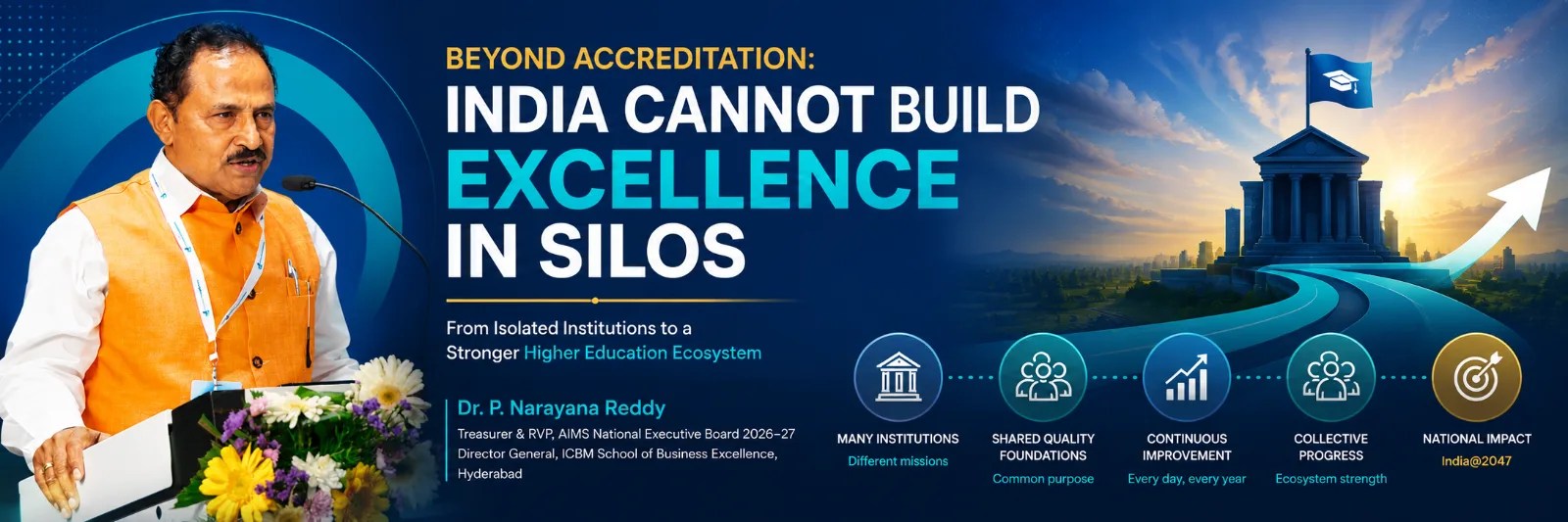
What does it really take to transform India’s higher-education ecosystem?
At Beyond Accreditation: Bangalore Summit 2026, much of the conversation revolved around a familiar aspiration: building world-class institutions.
But during his Guest of Honour address, Dr. P. Narayana Reddy, Treasurer & RVP, AIMS National Executive Board 2026–27 and Director General, ICBM School of Business Excellence, Hyderabad, introduced a perspective that widened the question.
The question is not simply:
How do we build a few world-class institutions?
It is:
How do we build a higher-education ecosystem in which quality and excellence can become widespread?
That distinction matters.
The Scale of the Challenge
India’s higher-education landscape is enormous and deeply diverse.
Institutions differ in their history, governance, disciplines, resources, geography and aspirations. Central universities, state universities, specialised institutions, engineering colleges, management institutions and affiliated colleges cannot simply be treated as identical entities.
Yet they are all part of the same national higher-education ecosystem.
Dr. Reddy’s intervention brought this tension to the forefront: India’s aspirations cannot be fulfilled if excellence remains concentrated in only a small number of institutions.
This is where accreditation takes on a larger significance.
Accreditation is not merely a certificate.
It can become a mechanism for creating a baseline of quality, from which institutions can begin their own journeys of improvement.
But the journey cannot stop there.
From “Who Is Excellent?” to “How Do We Create Excellence?”
For years, institutional conversations around quality have often been framed competitively:
Who has the highest ranking?
Who has the strongest accreditation?
Who is among the top institutions?
These questions have their place.
But they do not answer the larger national question.
If India wants its higher-education system to contribute meaningfully to its aspirations for 2047, the more important question becomes:
How do we create the conditions for thousands of institutions to improve?
This requires a shift in thinking.
From isolated excellence to ecosystem excellence.
A handful of exceptional institutions can demonstrate what is possible.
But an ecosystem creates the conditions for what is repeatable, scalable and sustainable.
Diversity Should Not Become Fragmentation
India’s institutional diversity is both a strength and a challenge.
Different institutions serve different purposes. A technical institution cannot be evaluated in exactly the same way as a management school. A state university operates within a different context from a specialised national institution.
Yet diversity does not mean that every institution needs an entirely disconnected definition of quality.
This becomes particularly relevant to the later “Many Frameworks to One” conversation at the summit.
Dr. Reddy argued that it is not impossible to work towards a common set of criteria despite differences between institutional types.
The opportunity lies in finding the common ground:
Different contexts.
Different missions.
Different disciplines.
But potentially:
A shared foundation of quality.
Accreditation Should Start a Journey, Not End One
One of the most important distinctions in the Beyond Accreditation conversation is between meeting standards and building a culture of improvement.
Accreditation can answer:
“Does this institution meet the required expectations?”
But excellence asks:
“What can this institution become?”
That second question is continuous.
It requires institutions to introspect, measure outcomes, learn from evidence, strengthen leadership, engage stakeholders and improve year after year.
The broader summit conversation repeatedly returned to this idea: accreditation should not become a one-time exercise of preparing documents, submitting evidence and waiting for a grade. Quality has to become part of everyday institutional life.
The 2047 Question
India’s 2047 ambition gives this conversation a longer horizon.
The next two decades cannot simply be about making institutions compliant.
They have to be about building capability.
Capability to:
- Educate better
- Research better
- Innovate
- Collaborate
- Serve society
- Create employable and entrepreneurial graduates
- Build global partnerships
- Use data intelligently
- Continuously improve
And that capability cannot remain confined to a few institutions.
It has to move through the ecosystem.
One Nation, Many Institutions — A Shared Quality Direction
Perhaps the most powerful implication of Dr. Reddy’s perspective is that standardisation and diversity do not necessarily have to be opposites.
India can preserve institutional diversity while creating common expectations around fundamental dimensions of quality.
That could mean moving towards:
Many institutions
↓
Different missions
↓
Different contexts
↓
Shared quality foundations
↓
Continuous improvement
↓
Collective national impact
This is not about making every institution identical.
It is about ensuring that every institution has a meaningful pathway towards excellence.
Beyond Accreditation
The title of the summit therefore carries a deeper meaning.
Going beyond accreditation does not mean ignoring accreditation.
It means asking what comes after the minimum standard has been established.
It means moving:
From compliance → to capability
From certification → to continuous improvement
From institutional competition → to ecosystem strengthening
From fragmented frameworks → to shared quality foundations
From individual excellence → to collective progress
And ultimately:
From institutional quality to national impact.
Dr. Narayana Reddy’s message reminds us that India’s higher-education transformation cannot be measured only by the number of highly ranked or internationally accredited institutions.
The bigger measure is whether quality becomes possible, practical and sustainable across the ecosystem.
Because if India’s ambition is 2047, the question is no longer:
“How many institutions can become world-class?”
It is:
“How do we build a higher-education system capable of producing excellence at scale?”
1
Discussion
0 comments