
Beyond Grades: How Maturity-Based Accreditation Is Changing Higher Education in India
By Studium Tech Pvt Ltd · 24 Aug 2026 · 31 views · edited 24 Aug 2026
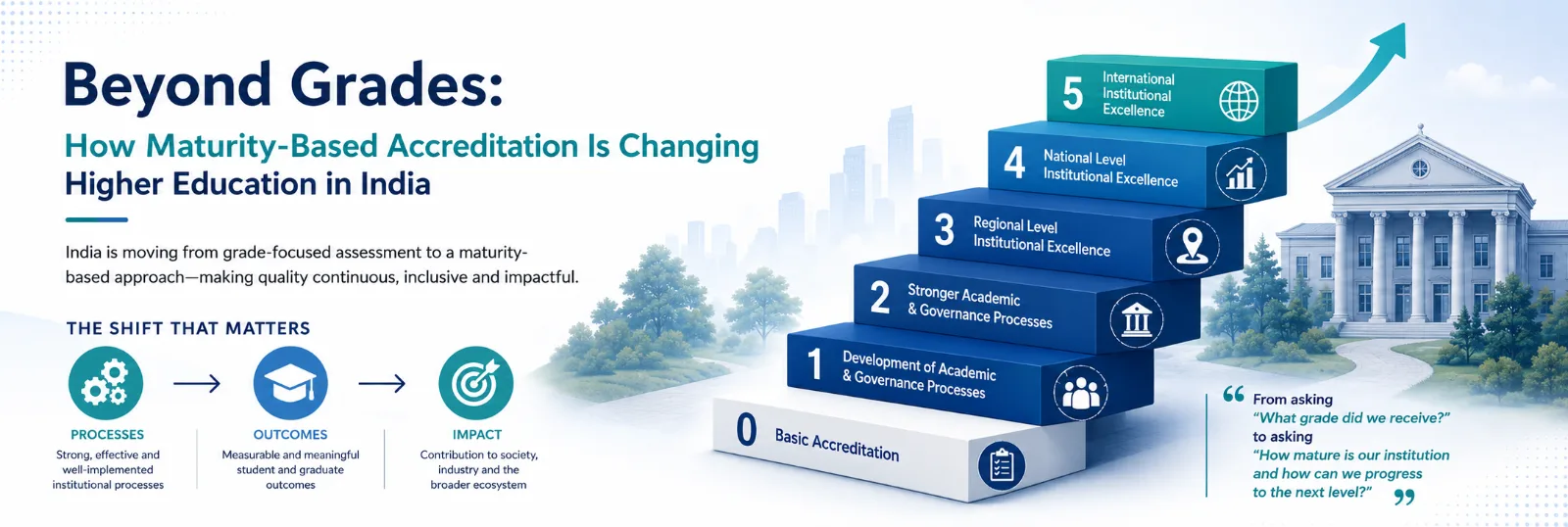
From Grade-Chasing to Continuous Improvement
For years, accreditation has been an important part of how quality is assessed across Indian higher education. Yet the accreditation process has also created a familiar institutional pattern: intense preparation around evaluation visits, followed by a return to routine once the assessment is complete.
As Dr. Anil Sahasrabudhe observed, institutions can sometimes enter a period of extraordinary activity once an accreditation visit is announced, focusing on preparing and recreating data rather than embedding quality into everyday institutional practice.
This raises a fundamental question:
Can quality assurance be effective if quality becomes most visible only when an assessment is approaching?
India's emerging shift towards Maturity-Based Graded Levels (MBGL) represents an attempt to address precisely this challenge.
The objective is not simply to change how institutions are graded. It is to change how institutions think about quality itself.
Why India's Accreditation Model Is Changing
The traditional accreditation model placed significant emphasis on institutional assessment and graded outcomes. Over time, however, concerns emerged around the complexity of the process, the pressure associated with high-stakes grades and the uneven participation of institutions across the country.
The source material highlights three significant challenges.
First, the high reputational stakes associated with grades could encourage institutions to focus heavily on securing a particular outcome.
Second, differences between accreditation outcomes and other measures of institutional performance, including national rankings, raised questions about how quality should be measured.
Third, many institutions—particularly those with fewer resources—remained outside the formal accreditation ecosystem. The source notes that, despite India's large higher education landscape, only a minority of colleges and universities had participated in accreditation.
The challenge, therefore, is not simply to make accreditation easier.
It is to make quality improvement more accessible, continuous and meaningful.
What Is Maturity-Based Graded Accreditation?
The proposed maturity-based framework introduces a progressive pathway rather than expecting every institution to demonstrate the same level of sophistication from the outset.
The model begins with Basic Accreditation, or Level 0, which is intended to provide institutions with a simpler entry point into quality assurance. Once institutions establish this baseline, they can progress through Maturity-Based Graded Levels 1 to 5.
The progression is designed to reflect increasing levels of institutional maturity:
- Level 0: Basic Accreditation
- Levels 1–2: Development of stronger academic and governance processes
- Levels 3–4: Regional and national levels of institutional excellence
- Level 5: International institutional excellence
This changes the fundamental question institutions are being asked to answer.
Instead of:
“What grade did we receive?”
the emphasis moves towards:
“How mature is our institution, and how can we progress to the next level?”
That is a fundamentally different approach to quality assurance.
From Accreditation as an Event to Quality as a Process
Perhaps the most important implication of the maturity-based model is its emphasis on continuous improvement.
A traditional assessment can create a defined moment of institutional scrutiny: prepare the documents, undergo the evaluation, receive the grade and move forward.
A maturity-based system instead encourages institutions to see quality as a year-over-year progression.
This means that quality cannot remain the responsibility of a small accreditation team.
It has to become part of institutional culture.
For academic leaders, this requires a shift from assessment preparation to institutional development.
The question is no longer simply whether an institution is ready for its next accreditation cycle.
It is whether the institution is continuously becoming better.
The Shift from Inputs to Outcomes and Impact
The maturity-based approach also changes what institutions need to demonstrate.
Historically, accreditation has placed considerable emphasis on institutional inputs: infrastructure, built-up area, classrooms, laboratories and faculty-student ratios. These indicators remain important as foundational requirements, but they do not necessarily demonstrate whether students are receiving a high-quality education.
The emerging framework places greater emphasis on three interconnected dimensions:
Processes → Outcomes → Impact
1. Stronger Institutional Processes
Institutions need to demonstrate that their academic and governance processes are working effectively.
This includes curriculum relevance, regular curriculum revision, faculty development, teaching-learning practices and transparent student evaluation.
2. Measurable Graduate Outcomes
Institutional quality ultimately has to be visible in what students achieve.
This can include placements, academic outcomes, entrepreneurial activity and the ability of graduates to apply their knowledge beyond the classroom.
The emphasis therefore moves from asking what an institution has to understanding what its students and graduates are able to do.
3. Societal and Ecological Impact
The final dimension is broader than institutional performance.
Higher education institutions are also expected to demonstrate their contribution to their communities and environment. Community engagement, social initiatives and responsible resource consumption become part of the larger definition of institutional quality.
This represents an important evolution in the meaning of quality.
An institution is not operating in isolation.
Its impact extends beyond the campus.
What Maturity-Based Accreditation Means for Academic Leaders
A new accreditation framework cannot create a quality culture by itself.
Institutional leadership remains critical.
The source material identifies four practical areas that academic leaders need to consider.
1. Leadership Must Model Quality
Quality cannot simply be communicated through policies and circulars.
Senior leaders need to demonstrate the transparency, ethics and standards they expect from their institutions.
2. Quality Must Move Beyond the IQAC
Institutional quality cannot belong exclusively to an Internal Quality Assurance Cell or a small administrative team.
Faculty, administrative staff and students all contribute to institutional quality. Everyone should understand how their everyday responsibilities connect to the institution's broader vision and goals.
3. Data Should Become Part of Everyday Operations
One of the clearest ways to reduce the administrative burden of accreditation is to stop treating data collection as a periodic exercise.
Integrated institutional systems can allow academic and student information to be captured continuously, creating a more reliable foundation for quality assessment and decision-making. The source specifically highlights ERP integration and national digital systems such as the Academic Bank of Credits and APAR IDs.
The long-term objective is simple:
Data should be a byproduct of institutional operations, not a last-minute accreditation exercise.
4. Faculty Evaluation Should Recognise Different Strengths
Not every faculty member contributes to institutional excellence in the same way.
Some may excel in research. Others may be exceptional educators, mentors, administrators or community contributors.
A mature quality culture should recognise these differences rather than forcing every faculty member into an identical performance model.
This makes faculty development part of institutional strategy rather than simply a compliance requirement.
Can Better Accreditation Improve Rankings?
Rankings remain an important consideration for many higher education institutions.
But the maturity-based approach suggests a different relationship between institutional improvement and rankings.
Instead of treating rankings as a target that requires a separate set of activities, institutions can focus on improving the underlying capabilities that rankings attempt to measure.
- Better teaching.
- Stronger graduate outcomes.
- Meaningful research.
- Entrepreneurship.
- Institutional governance.
- Community impact.
- International engagement.
If these capabilities improve consistently, stronger external recognition can become an outcome of institutional excellence rather than the sole objective. The source explicitly frames rankings and awards as potential byproducts of sustained institutional transformation.
What Changes for Institutions?
The transition to maturity-based accreditation requires a change in institutional mindset.
| Traditional Approach | Maturity-Based Approach |
| Prepare for the assessment | Improve continuously |
| Focus on grades | Focus on institutional maturity |
| Compile data periodically | Capture data continuously |
| Emphasise inputs | Measure processes and outcomes |
| Centralise quality responsibility | Build institution-wide ownership |
| Treat faculty uniformly | Recognise individual strengths |
| Chase rankings | Build capabilities that produce strong outcomes |
The difference is ultimately cultural.
Compliance asks whether an institution meets a standard.
Maturity asks whether an institution is capable of continuously improving beyond that standard.
The Larger Implication for Indian Higher Education
The significance of maturity-based accreditation extends beyond the accreditation process itself.
It points towards a broader transformation in how institutional quality is understood in India.
If successful, the model could help create a higher education ecosystem in which institutions are not simply preparing to demonstrate quality but are continuously building it.
That requires a move away from episodic compliance and towards institutional learning.
From documentation to data.
From infrastructure to outcomes.
From individual performance to institutional impact.
And ultimately, from achieving a grade to building a culture of excellence.
The Future of Accreditation Is Continuous Improvement
India's accreditation landscape is entering a period of significant change.
The move towards Basic Accreditation and Maturity-Based Graded Levels introduces a more progressive way of thinking about institutional quality: establish a baseline, build institutional capability, measure meaningful outcomes and continuously move towards higher levels of maturity.
For higher education leaders, the implication is clear.
The goal should not be to create an institution that performs exceptionally during an accreditation visit.
The goal should be to create an institution where quality is visible every day—in its teaching, its data, its governance, its graduates and its impact on society.
That is what it means to move beyond accreditation.
Not fewer standards. Higher standards of institutional maturity.
Key Takeaways for Higher Education Leaders
- Basic Accreditation can create a more accessible entry point for institutions beginning their quality journey.
- Maturity-Based Graded Levels shift the focus from grades to continuous institutional development.
- Quality assessment needs to move beyond inputs towards processes, outcomes and societal impact.
- Quality culture must be institution-wide, rather than the responsibility of a single department or accreditation team.
- Technology can make quality data continuous and actionable, rather than a last-minute compliance exercise.
- Faculty evaluation should recognise different forms of contribution and individual strengths.
- Rankings can become an outcome of sustained institutional improvement rather than the sole objective.
0
Discussion
0 comments