
Building World-Class Institutes: From Accreditation to Continuous Improvement
By Studium Tech Pvt Ltd · 24 Aug 2026 · 45 views · edited 24 Aug 2026
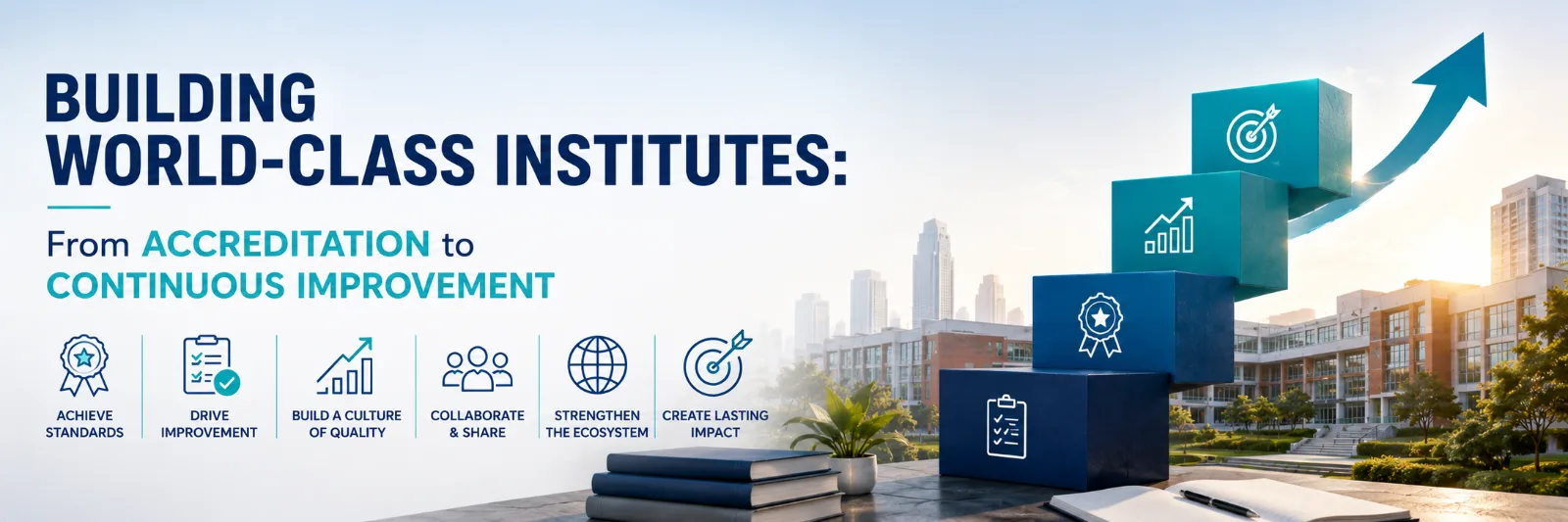

Indian higher education is entering a new phase.
Institutions today operate in an increasingly competitive environment shaped by accreditation, national rankings, global benchmarks and growing expectations around institutional quality.
But the next question is harder:
What happens after an institution meets the standard?
That was the central question behind Beyond Accreditation – Bangalore Summit 2026, an in-person conference focused on the future of quality in Indian higher education.
Accreditation in higher education provides institutions with a structured way to evaluate themselves against defined quality standards. In India, frameworks such as NAAC accreditation and NBA accreditation help institutions assess and demonstrate quality across different dimensions.
But accreditation is only one part of the larger journey.
The more important question is whether institutions can use these frameworks to build a culture of continuous improvement, collaboration and long-term institutional excellence.
The discussion around Beyond Accreditation begins here:
How do we move from demonstrating quality to continuously creating it?
The next stage of Indian higher education is about more than benchmarks
Indian institutions have made significant progress in expanding access, strengthening academic systems and participating in national and global quality frameworks.
Accreditation and rankings have played an important role in this journey.
They create benchmarks.
They encourage institutions to examine their processes.
They provide external perspectives on institutional performance.
But benchmarks can only tell part of the story.
The larger challenge is understanding what happens between assessments.
An institution may achieve accreditation.
It may improve its ranking.
It may meet a particular benchmark.
But is quality becoming part of how the institution operates every day?
This is where the conversation needs to move from achievement to improvement.
Accreditation should be a catalyst, not the destination
Going beyond accreditation does not mean moving away from accreditation.
It means changing how accreditation is understood.
Rather than treating accreditation as the final destination, institutions can view it as a starting point for deeper institutional development.
The important question is no longer simply:
“Have we achieved the required standard?”
It becomes:
“What can we improve beyond the standard?”
This shift changes the purpose of quality systems.
An accreditation framework can help an institution identify gaps, establish processes and understand where it stands.
But the real value comes from what happens afterwards.
Does the institution use the learning to improve academic practices?
Does it strengthen governance?
Does it develop faculty?
Does it improve student outcomes?
Does it build stronger research and industry relationships?
Does it create systems that continue working even when no assessment team is visiting?
That is where accreditation becomes a catalyst for institutional quality rather than an endpoint.
Quality becomes meaningful when it becomes continuous
One of the biggest challenges for Indian higher education is moving from periodic quality exercises to continuous quality improvement.
Quality cannot depend entirely on an upcoming accreditation cycle.
It cannot become active only when documentation is being prepared or an external assessment is approaching.
A stronger institutional culture asks a different question:
How can we improve, even when nobody is evaluating us?
This requires quality to become embedded across the institution.
Academic departments, leadership teams, faculty, administrators and support functions all have a role to play.
The responsibility for quality therefore moves from a single quality department to the institution as a whole.
That is the difference between quality as a framework and quality as a culture.
The future of Indian higher education cannot be built in isolation
Another important idea behind Beyond Accreditation is that the challenges facing higher education rarely belong to one institution alone.
Institutions operate within a much larger ecosystem.
Engineering institutions, universities, business schools, academic leaders, accreditation stakeholders and other participants experience quality from different perspectives.
Frameworks such as NAAC, NBA and NIRF, along with international accreditation and quality approaches, also bring different expectations and ways of thinking about institutional excellence.
This diversity matters.
A practice that works well for one institution may not necessarily work in exactly the same way for another.
The future therefore requires spaces where institutions can come together, exchange experiences and ask difficult questions about what comes next.
The goal is not simply to compare institutions.
It is to understand how the ecosystem can progress together.
Institutional excellence and national progress must move together
There is an important distinction between asking:
“How is my institution performing?”
and asking:
“How is Indian higher education progressing?”
Both questions matter.
Institutional excellence remains essential. Every institution must work towards stronger academic systems, better outcomes, meaningful research and effective governance.
But institutions also contribute to something larger.
They create knowledge.
They develop talent.
They collaborate with industry and society.
They influence communities.
They contribute to the country's academic and economic development.
This means that the future of Indian higher education cannot be defined only by individual institutional success.
India's global position will also depend on how effectively its institutions collaborate, share knowledge and strengthen the larger higher education ecosystem.
The next stage therefore requires both:
Institutional excellence.
Collective progress.
What should define the next five years?
This leads to a larger question:
What should Indian higher education aspire to over the next five years?
The answer cannot come from one institution.
It cannot come from one ranking.
And it cannot come from one accreditation framework.
The next phase requires dialogue between institutions, academic leaders, quality professionals, accreditation stakeholders and the wider higher education ecosystem.
It requires institutions to question existing approaches.
It requires them to exchange what works—and what does not.
It requires a willingness to look beyond compliance and ask what kind of institutions India needs for the future.
The conversation is therefore shifting from:
“How do we meet today's standards?”
to:
“How do we help shape tomorrow's standards?”
Beyond accreditation means building on what already exists
The idea of going beyond accreditation is not about abandoning the systems that already exist.
NAAC, NBA, NIRF and other quality and benchmarking frameworks continue to have an important role in Indian higher education.
The opportunity lies in building on them.
Accreditation can provide direction.
Rankings can provide comparison.
Quality frameworks can provide structure.
But institutions themselves must determine what they do with that learning.
The real measure of institutional quality is not simply whether a framework has been completed.
It is whether the institution becomes better because of the process.
The next chapter of Indian higher education quality
India has reached a point where the conversation around quality needs to evolve.
The focus cannot remain only on achieving another accreditation, improving another ranking or meeting another benchmark.
The more important questions are:
How do institutions continue improving?
How do they collaborate?
How do they respond to emerging challenges?
How do they create meaningful academic and societal impact?
How do they contribute to the progress of Indian higher education as a whole?
These questions take the conversation beyond accreditation.
Because the future of Indian higher education quality will not be defined only by the standards institutions meet today.
It will be defined by the standards they are willing to create for tomorrow.
Accreditation can show where an institution stands.
Continuous improvement determines where it goes next.
Insights from Beyond Accreditation – Bangalore Summit 2026, presented by Studium under the Higher Education Quality Forum (HEQF).
Key Takeaways
- Accreditation is a milestone, not the destination — frameworks such as NAAC and NBA should become catalysts for deeper institutional improvement.
- Quality needs to become continuous — institutions must move from periodic assessment exercises to an everyday culture of improvement.
- The responsibility for quality is shared — quality cannot remain limited to one department; it needs ownership across the institution.
- Institutions cannot progress in isolation — collaboration and knowledge-sharing are essential for strengthening the wider higher education ecosystem.
- Institutional excellence and national progress go together — individual institutions must become stronger while contributing to the development of Indian higher education as a whole.
- The next benchmark is what comes after the benchmark — the real question is whether institutions continue to improve once the accreditation, ranking or assessment cycle is over.
0
Discussion
0 comments