
From Accreditation to Excellence: Rethinking What Makes a University World-Class
By Studium Tech Pvt Ltd · 24 Aug 2026 · 27 views · edited 24 Aug 2026
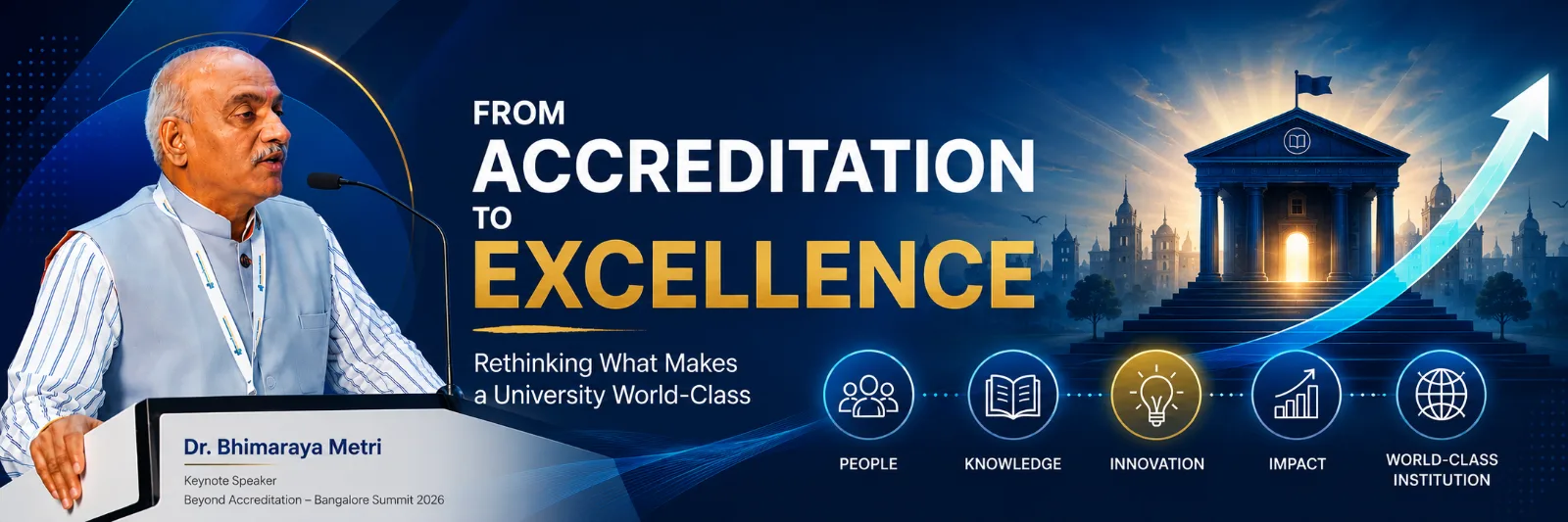
What defines a world-class institution?
For Dr. Metri, the answer begins with outcomes.
A world-class institution produces graduates who are valued by the market, generates research that creates meaningful impact and develops an environment where faculty and students can innovate.
But these outcomes require a strong institutional ecosystem.
Talent + Resources + Autonomy + Research + Innovation + Impact
Together, these become the building blocks of a world-class institution.
Empowering the people who create excellence
Faculty members are at the heart of any academic institution. At the same time, talented people need resources, infrastructure and an environment that allows them to perform.
This is where institutional autonomy and academic freedom become critical. Institutions must have enough flexibility to experiment, make decisions and respond to opportunities rather than being constrained by excessive centralisation.
Making research meaningful
Another important message from the keynote was the need to rethink how research is valued.
Research should not be measured only by the number of papers published or the prestige of the journal. Its larger purpose is to create knowledge that can eventually contribute to society, business, government, communities and policy.
This also creates an opportunity for institutions to strengthen their ecosystems around technology transfer, patents, startups and industry collaboration.
Don't let accreditation become the destination
Institutions can spend enormous effort preparing for accreditation, only to return to their previous ways of working once the assessment is complete.
Dr. Metri challenged this approach.
A truly excellent institution should not need to “switch on” quality every few years. Quality should be part of how the institution operates every day.
Accreditation, therefore, should become a natural reflection of continuous institutional development rather than the sole objective driving it.
Thinking beyond the framework
The keynote also highlighted the growing complexity of higher education, where institutions engage with multiple accreditation, ranking and reporting frameworks.
The opportunity lies in creating stronger institutional data systems where information can serve multiple purposes rather than being collected repeatedly for every framework.
This represents a broader shift:
From fragmented compliance → integrated institutional intelligence.
The HEQF takeaway
Building a world-class institution is a long-term journey. It requires institutions to continuously invest in people, knowledge, autonomy, innovation and impact.
Accreditation can validate that journey—but it should never define it.
Going beyond accreditation means asking a bigger question: not “How do we meet the framework?” but “How do we become an institution worthy of being called world-class?”
Insights from the keynote session at Beyond Accreditation – Bangalore Summit 2026, presented by Studium under the Higher Education Quality Forum (HEQF).
Key Takeaways
- World-class institutions are built on outcomes — graduate success, impactful research, innovation, and societal value matter more than compliance alone.
- People are the foundation of excellence — faculty and students need talent, resources, infrastructure, autonomy, and academic freedom to thrive.
- Research must create real-world impact — institutions should move beyond publication counts toward patents, startups, technology transfer, industry collaboration, and societal impact.
- Quality should be continuous, not periodic — accreditation should reflect an institution’s everyday culture of quality rather than trigger short-term preparation.
- Institutional intelligence can replace fragmented compliance — integrated data systems can support multiple accreditation, ranking, and reporting needs without repeatedly collecting the same information.
- Excellence goes beyond accreditation — the real question is not “How do we meet the framework?” but “How do we become a world-class institution?”
0
Discussion
0 comments