
From Evidence to Impact: What Going Beyond Accreditation Really Means
By Studium Tech Pvt Ltd · 24 Aug 2026 · 20 views · edited 24 Aug 2026
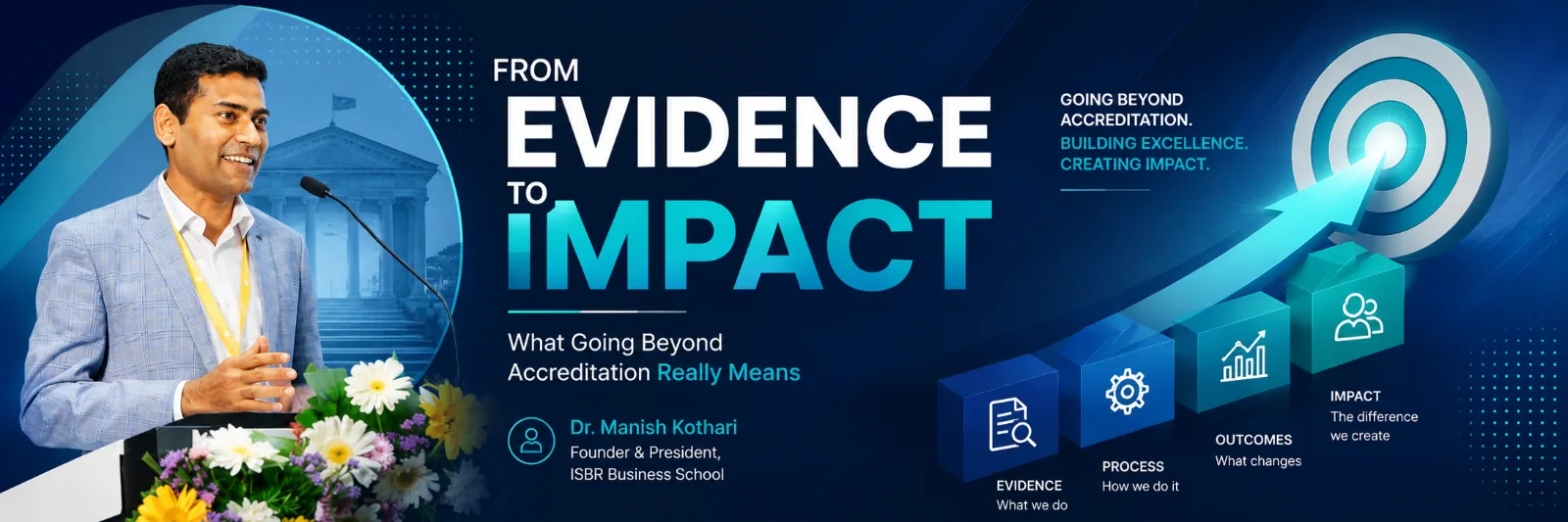
What does it really mean to go beyond accreditation?
For Dr. Manish Kothari, the answer comes from an important lesson from ISBR's own accreditation journey: quality cannot remain a documentation exercise or a periodic activity. It has to become part of how an institution works every day.
At Beyond Accreditation – Bangalore Summit 2026, Dr. Kothari reflected on the lessons institutions can learn when they move from preparing for accreditation to building a genuine culture of quality and institutional excellence.
Five lessons from the accreditation journey
1. Documentation is not quality
Institutions can have extensive documentation and still struggle to create meaningful outcomes.
The first shift is therefore to stop confusing evidence of activity with evidence of quality. Documentation should demonstrate what an institution is doing—not become the definition of quality itself.
2. Quality cannot belong to the quality department
One of the most common mistakes is treating quality as the responsibility of an IQAC or quality team alone.
Quality needs to move end-to-end across the institution—from academic departments and faculty to administration, student services and leadership.
When every stakeholder owns quality, it becomes part of institutional culture rather than an administrative function.
3. Quality cannot wake up six months before an inspection
Dr. Kothari highlighted the familiar cycle institutions experience when an accreditation or assessment visit approaches: departments become active, documents are gathered and processes receive renewed attention.
But sustainable quality cannot operate on an inspection calendar.
Continuous improvement has to replace periodic preparation.
4. Measure outcomes, not just activities
How many guest lectures were conducted?
How many events happened?
How many initiatives were organised?
These numbers tell us what happened—but not necessarily what changed.
Going beyond accreditation means asking the more important questions:
What was the outcome? What changed for the student? What value was created? What impact did the initiative have?
5. Don't be afraid to discover your problems
Institutional improvement begins with the willingness to identify what is not working.
A mature quality culture does not hide problems to look better during an assessment. It uses problems as opportunities to improve.
What happens when quality becomes a habit?
Dr. Kothari shared five outcomes from this shift:
Quality becomes faster.
Processes become part of everyday work rather than last-minute preparation.
Quality becomes cheaper.
When quality is embedded into routine processes, institutions don't have to repeatedly invest extraordinary effort to demonstrate it.
Quality becomes scalable.
A strong quality culture can support institutional growth and expansion.
Quality becomes visible.
Students, faculty and other stakeholders begin to experience quality rather than simply seeing it documented.
Quality becomes reputation.
And ultimately, this is where quality creates lasting institutional value.
The Bigger Idea
For Dr. Kothari, Beyond Accreditation is ultimately about moving from evidence to impact.
It is about changing the institutional mindset from:
“Can we prove that we did it?”
to:
“What difference did it make?”
That is the shift that transforms accreditation from a compliance exercise into a continuous journey of institutional excellence, quality culture and meaningful impact.
1
Discussion
0 comments