
How to Calculate Attainment in OBE: A Complete Step-by-Step Workbook with Examples
By Studium Tech Pvt Ltd · 8 Aug 2026 · 19 views
In many institutions today, the conversation around OBE revolves around:
- Achieving attainment level 3
- Improving attainment percentages
- Generating attainment reports for accreditation.
However, the real purpose of attainment was never to merely generate scores.
Attainment is supposed to answer a much deeper academic question:
“Are students actually achieving the intended learning outcomes?”
Unfortunately, many institutions today:
- Set arbitrary thresholds
- Design weak assessments
- Inflate attainment values
- Focus more on compliance than learning.
As a result:
- Attainment loses meaning
- OBE becomes post-facto documentation
- Academic improvement never truly happens.
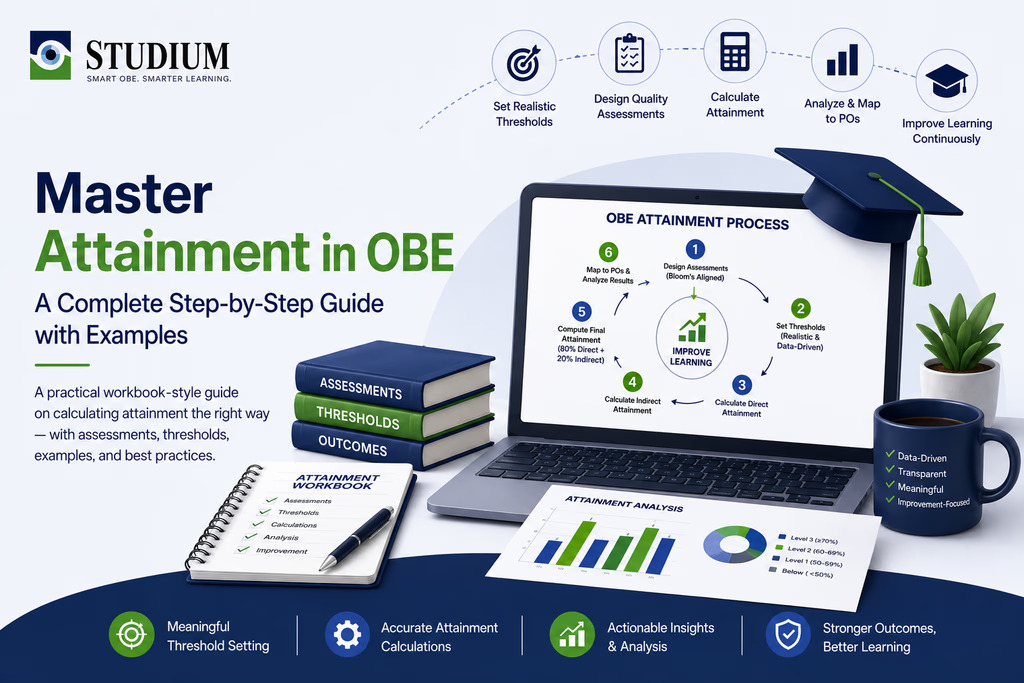
This workbook-style guide explains how institutions should correctly:
- Design assessments
- Define thresholds
- Calculate attainment
- Analyze learning outcomes
- Use attainment for academic intelligence.
This framework is also the foundation of the attainment methodology used inside Studium’s Smart OBE platform.
What is Attainment in Outcome-Based Education?
Attainment is the process of measuring:
“To what extent have students achieved the defined Course Outcomes (COs) and Program Outcomes (POs)?”
In simple words:
- Attainment tells whether learning has actually happened.
Attainment should not be viewed only as a mathematical calculation.
It reflects:
- Teaching effectiveness
- Assessment quality
- Curriculum alignment
- Student understanding
- Learning depth
Why Attainment is Often Misunderstood
One of the biggest misconceptions in OBE implementation is:
“Higher attainment automatically means better learning.”
This is not always true. Institutions can artificially increase attainment by:
- Lowering thresholds
- Simplifying assessments
- Inflating marks
- Conducting weak evaluations.
This creates:
- attainment inflation
- weak learning systems
- misleading academic quality indicators.
The objective of OBE should never be:
“How do we increase attainment?”
Instead, the objective should be:
“How do we improve learning?”
Understanding Direct and Indirect Attainment
Attainment in OBE is generally divided into two components:
1.Direct Attainment
2.Indirect Attainment
Direct Attainment
Direct attainment is measured through:
- internal assessments
- assignments
- quizzes, projects
- presentations
- case studies
- examinations
It directly evaluates whether students have achieved the defined Course Outcomes.
Indirect Attainment
Indirect attainment captures:
“How confident students feel about achieving the intended outcomes.”
This is generally measured through:
- Course Exit Surveys
- student feedback
- learner confidence analysis
Indirect attainment adds:
- a qualitative dimension
- learner perception
- reflective academic feedback
Typical Weightage Structure
Most institutions use:
| Component | Weightage |
|---|---|
| Direct Attainment | 80% |
| indirect Attainment | 20% |
This ensures:
- objective performance measurement
- while also considering learner confidence
Step 1: Design Assessments Before Calculating Attainment
One of the biggest mistakes institutions make is:
calculating attainment before designing meaningful assessments.
Attainment quality depends heavily on:
- how assessments are designed
- how Bloom’s taxonomy is applied
- whether competencies are correctly evaluated
Bloom’s Taxonomy and Assessment Design
Different Bloom’s levels require different modes of assessment.
| Bloom's Level | Suitable Assessment |
|---|---|
| Remember | Objective tests |
| Understand | Written explanations |
| Apply | Case studies / practical exercises |
| Analyze | Analytical assignments |
| Evaluate | Strategic critiques |
| Create | Projects / business plans |
Important Academic Insight
Many institutions incorrectly attempt to measure:
- Evaluate
- Create level learning
through:
- simple quizzes,
- memory-oriented written exams.
This creates weak attainment systems.
For example:
A high-order MBA course like Marketing Strategies should ideally include:
- case analysis
- business strategy exercises
- campaign design
- problem-solving projects.
Otherwise
- the attainment scores become mathematically correct
- academically meaningless
Understanding Low, Medium & High-Order Thinking Courses
Low-Order Thinking Courses
Focus on:
- Remember
- Understand
- Apply
Example:
- introductory foundation subjects.
Medium-Order Thinking Courses
Focus on: Analyze
Students begin:
- interpreting
- comparing
- analyzing concepts
High-Order Thinking Courses
Focus on:
- Evaluate
- Create
Students are expected to:
- make decisions
- solve strategic problems
- create solutions
- design frameworks.
This distinction is extremely important because:
threshold setting and attainment expectations should differ across thinking levels.
Step 2: Define Threshold Correctly
Threshold setting is one of the most important — and most ignored — components of attainment calculation.
What is Threshold?
Threshold is the minimum score expected from students in a particular assessment.
For example: students scoring above 60% may be considered as having achieved the outcome.
The Biggest Problem with Thresholds
Many institutions randomly define thresholds such as:
- 60%
- 70%
- 75%
without considering:
- subject complexity
- assessment difficulty
- historical student performance
- Bloom’s taxonomy level.
This creates:
- unrealistic attainment
- artificial inflation
- misleading analysis
Recommended Threshold Framework
A more academically meaningful approach is:
Step 1:
Analyze last 3 years’ student performance for the course.
Step 2:
Calculate moving average of marks.
Step 3:
Add tolerance margin of approximately 3–4%.
Example
Suppose:
| Year | Average Marks |
|---|---|
| 2023 | 58 |
| 2024 | 61 |
| 2025 | 60 |
Moving Average:
(58 + 61 + 60) / 3 = 59.67
Now add tolerance margin:
59.67 + 3 = 62.67
Recommended threshold ≈ 63%
This creates:
- realistic expectations
- fair evaluation
- meaningful attainment
Step 3: Define Attainment Levels
Most institutions convert attainment into:
- Level 1
- Level 2
- Level 3
Example:
| Percentage of Students Crossing Threshold | Attainment Level |
|---|---|
| ≥ 50% | Level 1 |
| ≥ 60% | Level 2 |
| ≥ 70% | Level 3 |
These ranges may vary institution to institution.
Step 4: Calculate Direct Attainment
Now let us calculate direct attainment correctly.
Direct attainment is not calculated by directly taking the percentage of students above threshold as the attainment score.
The correct process is:
- Identify the percentage of students crossing the threshold in each assessment.
- Convert that percentage into an attainment level such as 1, 2, or 3.
- Identify which Course Outcomes are assessed in each assessment.
- Calculate the weighted average of attainment levels for each Course Outcome.
Example Assessment Structure
Suppose the course has:
| Assessment | Weightage |
|---|---|
| Internal Assessment 1 | 20% |
| Internal Assessment 2 | 20% |
| Assessment | 20% |
| End Semester Exam | 40% |
Step 4.1: Define Attainment Level Rules
Before calculating attainment, the institution must define rules to convert percentage of students above threshold into attainment levels.
Example:
| Percentage of Students Above Threshold | Attainment Level |
|---|---|
| 50% to 59% | Level 1 |
| 60% to 69% | Level 2 |
| 70% and above | Level 3 |
These bands may vary from institution to institution.
Step 4.2: Identify COs Mapped to Each Assessment
Now identify which COs are assessed in each component.
Example:
| Assessment | Weightage | Course Outcomes Assessed |
|---|---|---|
| Internal Assessment 1 | 20% | CO1, CO2 |
| Internal Assessment 2 | 20% | CO2, CO3 |
| Assignment | 20% | CO1, CO3 |
| End Semester Exam | 40% | CO1, CO2, CO3 |
Step 4.3: Convert Each Assessment Performance into Attainment Level
Suppose for CO1, the following assessment performance is observed:
| Assessment | CO Assessed | Students Above Threshold | Attainment Level |
|---|---|---|---|
| Internal Assessment 1 | CO1 | 75% | 3 |
| Assignment | CO1 | 80% | 3 |
| End Semester Exam | CO1 | 68% | 2 |
Here:
- 75% students above threshold → Level 3
- 80% students above threshold → Level 3
- 68% students above threshold → Level 2
Step 4.4: Calculate Weighted Direct Attainment for CO1
Now calculate weighted average based on assessment weightages.
For CO1:
| Assessment | Weightage | Attainment Level |
|---|---|---|
| Internal Assessment 1 | 20% | 3 |
| Assignment | 20% | 3 |
| End Semester Exam | 40% | 2 |
Since CO1 appears only in these three assessments, we normalize the weights for these selected assessments.
Total applicable weightage for CO1: 20 + 20 + 40 = 80
Direct CO1 Attainment:
= [(3 × 20) + (3 × 20) + (2 × 40)] / 80
= (60 + 60 + 80) / 80
= 200 / 80
= 2.5
So, the direct attainment of CO1 is 2.5 out of 3.
General Formula for Direct CO Attainment
Direct CO Attainment =
Σ (Assessment Attainment Level × Assessment Weightage) / Σ (Applicable Assessment Weightage)
Where:
- Assessment Attainment Level is the level 1, 2, or 3 derived from students crossing the threshold.
- Assessment Weightage is the weightage assigned to that assessment.
- Applicable Assessment Weightage includes only those assessments where the particular CO is assessed.
Why This Method is Better
This method is more accurate because:
- it respects the weightage of each assessment
- it considers only the assessments where a CO is actually measured
- it avoids treating raw percentages as attainment scores
- it converts performance into a standardized attainment level.
This also makes the attainment process more audit-ready and easier to compare across courses.
Step 5: Calculate Indirect Attainment
Indirect attainment is usually calculated through:
- Course Exit Surveys
Example Course Exit Survey
Question: “How confident are you that you achieved CO1?”
Students respond on scale: 1 to 5.
Example Data
| Rating | Percentage of Students |
|---|---|
| 5 | 40% |
| 4 | 35% |
| 3 | 15% |
| 2 | 7% |
| 1 | 3% |
Weighted Indirect Attainment Formula
Indirect Attainment = Σ (Rating × Percentage)
Example Calculation
\= (5×40)+(4×35)+(3×15)+(2×7)+(1×3)
Normalized indirect attainment score can then be calculated.
Step 6: Final CO Attainment Calculation
Now combine:
- direct attainment
- indirect attainment.
Formula
Final CO Attainment = (Direct × 80%) + (Indirect × 20%)
Example
Suppose:
| Component | Score |
|---|---|
| Direct Attainment | 58 |
| Indirect Attainment | 72 |
Final Attainment:
\= (58 × 0.8) + (72 × 0.2)
Final CO Attainment = 60.8
Step 7: Mapping CO Attainment to PO Attainment
Once CO attainment is calculated:
- it contributes toward Program Outcome attainment.
The contribution depends on:
- CO-PO mapping strength
- articulation weightage
This creates:
- program-level learning intelligence
- curriculum analysis
- academic performance visibility
Common Mistakes Institutions Make in Attainment Calculation
1. Arbitrary Thresholds
Randomly setting 60% or 70% thresholds.
2. Easy Assessments
Artificially increasing attainment through simple exams.
3. Bloom’s Mismatch
Measuring high-order thinking through memory-based tests.
4. Post-Facto Attainment
Designing assessments only after teaching is completed.
5. Attainment Inflation
Focusing on increasing scores instead of improving learning.
What Faculty Members Should Check
Faculty should evaluate:
- whether assessments match Bloom’s taxonomy
- whether thresholds are realistic,
- whether competencies are being measured correctly.
Faculty should focus on:
- improving pedagogy
- not artificially increasing attainment
What IQAC Teams Should Check
IQAC teams should review:
- threshold consistency
- assessment quality
- attainment fairness
- articulation logic,
- year-on-year trends.
IQAC should ensure that:
- attainment reflects actual learning,
- not compliance-driven reporting.
How AI is Transforming Attainment Analysis
Modern AI-powered OBE systems can now:
- automate attainment calculations
- analyze weak learners
- identify curriculum gaps
- recommend threshold corrections
- generate improvement insights.
This transforms attainment from: static reporting, into academic intelligence.
Smart OBE and Intelligent Attainment Analysis
Studium’s Smart OBE platform follows the exact attainment framework discussed in this workbook.
The platform helps institutions:
- automate direct and indirect attainment
- analyze weak and strong learners
- identify curriculum gaps
- support IQAC reviews
- generate outcome improvement insights.
The objective is not merely to calculate attainment.
The objective is to improve:
- teaching quality
- learning effectiveness
- academic decision-making
Final Thoughts
Attainment should never be treated as:
- a mathematical reporting exercise
- or an accreditation formality.
Its real purpose is to help institutions understand:
- whether meaningful learning is happening
- whether pedagogy is effective
- whether curriculum outcomes are being achieved.
Institutions that use attainment intelligently are able to:
- improve teaching, strengthen assessments
- support weaker learners
- continuously enhance academic quality.
The future of OBE lies not in higher attainment scores
but in:
- smarter learning systems
- better curriculum alignment
- AI-assisted academic intelligence
0
Discussion
0 comments