
Indian Higher Education Quality Goes Beyond Accreditation
By Studium Tech Pvt Ltd · 24 Aug 2026 · 25 views · edited 24 Aug 2026
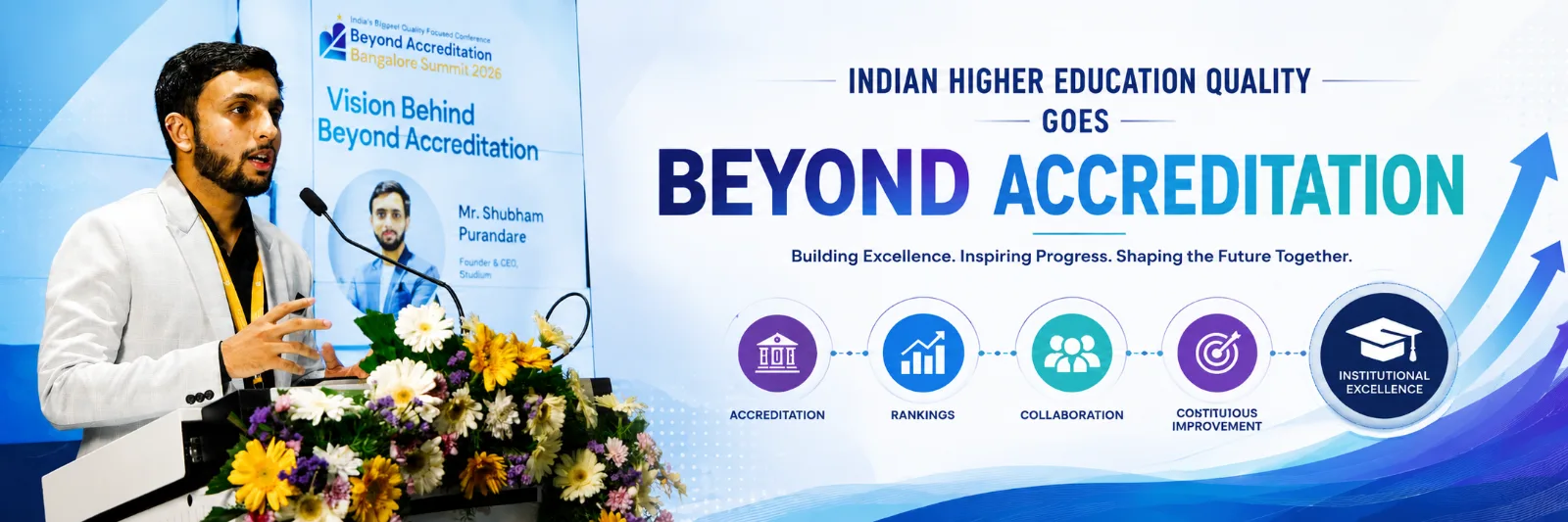
Indian Higher Education Quality Goes Beyond Accreditation
Indian higher education quality is entering a period of growing global ambition. As institutions increasingly focus on accreditation, national rankings and global rankings, questions of institutional quality and competitiveness are becoming more prominent.
But as these systems become increasingly important, another question deserves attention:
What comes after accreditation?
What Is Accreditation in Higher Education?
Accreditation in higher education is the formal process of evaluating an institution or programme against defined quality standards. In India, NAAC assesses institutions, while NBA accredits technical and professional programmes. It provides a benchmark for institutional quality and quality assurance in higher education.
Rankings provide another lens through which institutions are compared. Yet the future of Indian higher education cannot be defined by these measures alone.
The more important challenge is to understand how institutions can use these frameworks as a starting point for continuous improvement, collaboration and long-term academic excellence.
This is the thinking behind Beyond Accreditation Bangalore Summit 2026, an in-person conference on higher education quality held on 12 August 2026 at ISBR Business School, Bangalore.
Why Is Indian Higher Education Becoming More Competitive?
Indian institutions are operating in an environment where accreditation and rankings carry significant importance. The growing focus on national and global benchmarks reflects a broader aspiration: to strengthen the position of Indian higher education within the global academic ecosystem.
As institutions work towards these benchmarks, however, the conversation around quality needs to expand.
The question should not only be whether an institution meets a particular standard.
It should also be:
What is the institution doing to create meaningful, sustainable improvement beyond that standard?
This distinction is critical.
Accreditation can assess where an institution stands at a particular point in time. The larger challenge is creating an institutional culture where quality becomes an ongoing process rather than a periodic exercise.
Moving Beyond Compliance Towards Continuous Improvement
Going beyond accreditation does not mean moving away from accreditation.
Instead, it means changing how accreditation is understood.
Rather than treating accreditation as the final destination, institutions can view it as one component of a broader quality journey.
That journey can involve asking deeper questions about institutional development, academic practices, collaboration and the future capabilities required by Indian higher education.
This shifts the conversation from:
“Have we achieved the required standard?”
to:
“How can we continuously improve beyond the standard?”
For institutions seeking long-term excellence, that shift can be significant.
The Future of Indian Higher Education Requires Collaboration
One of the central ideas behind Beyond Accreditation Bangalore Summit 2026 is that the future of Indian higher education cannot be addressed by institutions working in isolation. The summit also launched the Higher Education Quality Forum (HEQF), a community for quality-focused peer learning and collaboration.
The conference brings together stakeholders from engineering institutions, private universities and business schools, alongside senior academicians and experts working across NAAC, NBA, NIRF and international accreditation frameworks such as EQUIS, AMBA and BGA.
This diversity matters because higher education challenges rarely belong to a single discipline or institution.
A framework that works for one institution may not necessarily address the challenges faced by another. Creating a stronger ecosystem therefore requires spaces where different institutions and academic leaders can exchange perspectives and collectively examine what comes next.
The goal is not simply to compare institutions.
It is to understand how the ecosystem can progress together.
Institutional Excellence vs. National Progress: Why India Needs Both
There is an important distinction between asking how an individual institution is performing and asking how Indian higher education is progressing as a whole.
The Beyond Accreditation vision places emphasis on the latter.
As the conference framing puts it, the focus is not only on what individual institutions are doing, but on what India can achieve in the field of higher education.
This creates a broader perspective on quality.
Institutional excellence remains important, but so does the ability of institutions to collaborate, share knowledge and contribute to the development of the larger higher education ecosystem.
For India to strengthen its position globally, these two perspectives need to work together:
institutional excellence and collective progress.
What Should Define the Next Five Years of Indian Higher Education?
This leads to perhaps the most important question:
What frameworks should Indian higher education adopt for the next five years?
The answer cannot come from a single institution or a single accreditation framework.
It requires dialogue between institutions, academic leaders, accreditation stakeholders and other participants across the ecosystem.
It is an attempt to create a platform where stakeholders can question existing approaches, exchange perspectives and explore frameworks for the next phase of higher education in India.
Accreditation Should Be a Milestone, Not the Destination
The conversation around accreditation will remain important.
But as Indian higher education becomes increasingly ambitious and globally connected, institutional quality needs to be understood through a wider lens.
The future cannot simply be about achieving another accreditation, improving another ranking or meeting another benchmark.
It must also be about what institutions do after achieving those milestones.
How do they continue improving?
How do they collaborate?
How do they prepare for emerging challenges?
And how do they contribute to a stronger Indian higher education ecosystem?
These are the questions that take the conversation beyond accreditation.
The Next Chapter of Higher Education Quality
India has reached a point where the conversation around higher education quality needs to evolve.
Accreditation and rankings can provide important benchmarks. But benchmarks alone cannot define the future.
The next phase requires a broader conversation—one focused on continuous improvement, collaboration and a shared understanding of where Indian higher education should go next.
Going beyond accreditation is ultimately not about abandoning existing frameworks.
It is about building on them.
Because the goal should not simply be to meet the standards of today.
It should be to help shape the standards of tomorrow.
Key Takeaway
For Indian higher education quality, accreditation should not be viewed as the end of the quality journey. It should be a foundation for continuous improvement, collaboration and building the future of institutional excellence.
0
Discussion
0 comments