
Many Frameworks to One: From Compliance to Institutional Intelligence
By Studium Tech Pvt Ltd · 24 Aug 2026 · 40 views · edited 24 Aug 2026
Chapter 3 | Beyond Accreditation – Bangalore Summit 2026
Higher education institutions today navigate an increasingly complex landscape of accreditation, rankings, quality assurance, regulatory requirements and institutional reporting.
But when every framework demands its own data, processes and documentation, an important question emerges:
Are institutions managing quality—or simply managing frameworks?
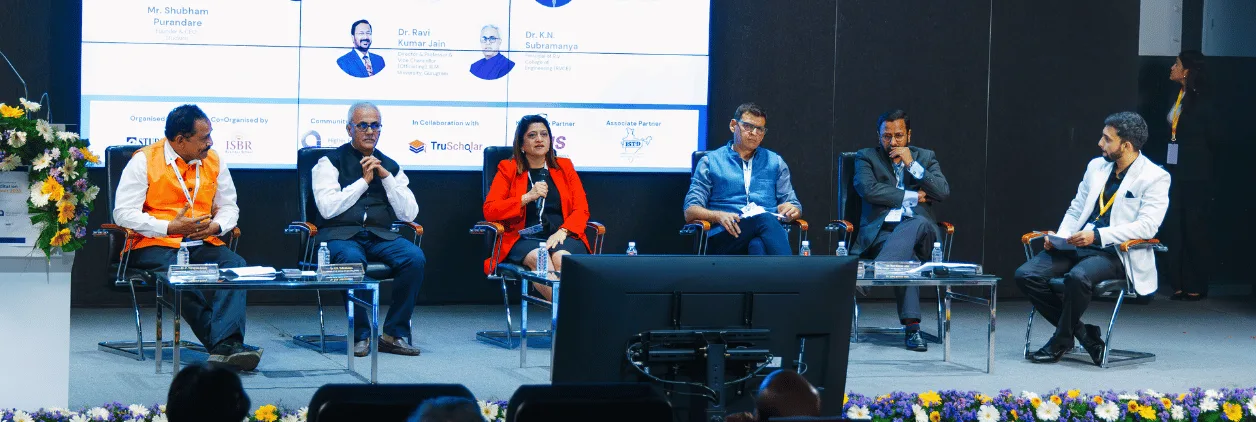
This question shaped the discussion in Chapter 3 at Beyond Accreditation – Bangalore Summit 2026, where academic and quality leaders explored how institutions can move towards a more integrated approach to institutional quality assurance.
The conversation, moderated by Mr. Shubham Purandare, brought together perspectives from Dr. Vishal Talwar, Ms. Shikha Taunk, Dr. Ravi Kumar Jain, Dr. K. N. Subramanya and Dr. P. Narayan Reddy.
A common message emerged: quality needs to become an institutional system, not an accreditation exercise.
Benchmarking should inspire capability—not imitation
Benchmarking is an important part of institutional improvement. But Dr. Vishal Talwar offered an important distinction:
“If you are looking at benchmarking for imitation, then there's a problem.”
Institutions should benchmark to understand where they stand, identify gaps and build capabilities—not simply copy what another institution is doing.
A meaningful benchmarking journey can happen at multiple levels:
Benchmark yourself → Benchmark your peers → Benchmark your aspirational institutions
But the purpose should remain improvement.
The question is not “How do we become like them?”
It is:
“What capabilities do we need to build to reach where we aspire to be?”
Strategy should be lived, not filed away
Benchmarking can show an institution where it wants to go. Strategic planning provides the path to get there.
Dr. K. N. Subramanya highlighted that a strategic plan should be more than a document created for a committee or displayed on a website.
It should be a living reflection of what an institution wants to achieve.
That means connecting institutional vision and mission to:
- Measurable Goals,
- KPIs,
- Timelines,
- Responsibilities,
- Risk Management,
- Continuous Review.
Importantly, strategy cannot remain the responsibility of senior leadership alone.
As the discussion highlighted, strong strategic planning requires stakeholder ownership.
When people participate in shaping the institution's future, they are more likely to take ownership of making that future happen.
Quality must move beyond IQAC
One of the strongest messages from the discussion was that quality cannot belong to one committee.
Accreditation committees, IQAC teams and quality offices play important roles, but they cannot independently create institutional quality.
Dr. Vishal Talwar emphasised that institutional quality needs to be driven from the top leadership downwards, with clear communication and ownership across the organisation.
Similarly, Dr. P. Narayan Reddy highlighted the importance of trustworthy academic leadership in translating institutional vision into action.
The result should be a shift from:
“The IQAC manages quality.”
to:
“The institution owns quality.”
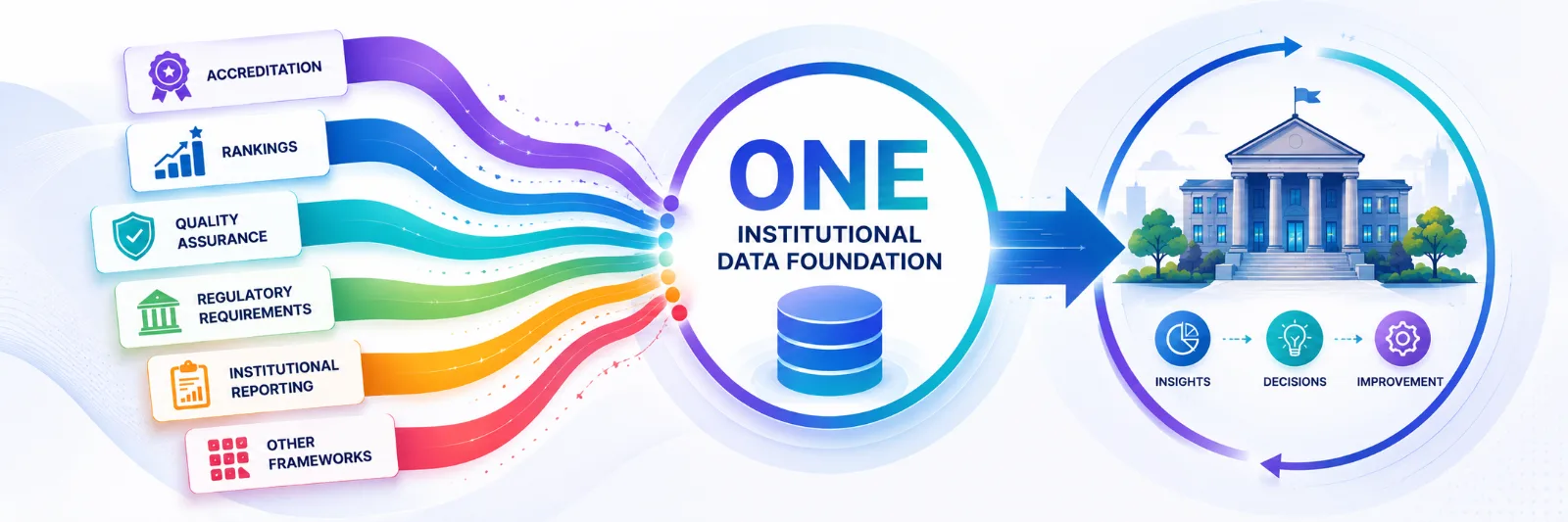
One Institution. One Data Foundation.
Perhaps one of the most significant discussions in the chapter centred on One Nation, One Data. Institutions today report similar information repeatedly to different bodies, often using different formats and timelines.
Dr. K. N. Subramanya shared an especially striking observation: his institution reports to numerous regulatory and government bodies, resulting in significant duplication of effort and substantial faculty and staff time spent on reporting.
This raises an important opportunity:
Capture data once. Clean it. Maintain it. Use it many times.
Instead of maintaining separate datasets for accreditation, rankings and regulatory requirements, institutions can work towards a common institutional data foundation.
Different frameworks may ask different questions—but the underlying institutional data can remain consistent.
From data collection to institutional intelligence
The next step is not simply storing more data.
It is making that data usable.
As the panel discussed, institutional data should ideally be captured at the point where activities happen, cleaned and maintained centrally, and then mapped into the requirements of different frameworks.
This opens the door to increasingly intelligent systems where technology and AI can help institutions:
- Identify missing information,
- Map evidence to frameworks,
- Identify gaps,
- Track institutional KPIs,
- Support decision-making, and
- Reduce repetitive reporting.
The larger shift is:
Data → Evidence → Insight → Decision → Improvement
That is the foundation of institutional intelligence.
Quality is a cycle, not a checklist
Dr. K. N. Subramanya brought the conversation back to a fundamental principle of quality management: the PDCA cycle — Plan, Do, Check, Act.
The model is simple, but its implications are significant.
Institutions plan an activity.
They implement it.
They review the results.
And, most importantly, they act on what they learn.
Without the final step, feedback simply becomes another dataset.
Quality improves when feedback leads to action.
This is where outcome-based education, stakeholder feedback, academic performance and institutional processes can come together into a continuous improvement cycle.
Measure what matters
For institutional leaders, the challenge is not to monitor every available metric.
It is to identify the indicators that reveal whether the institution is actually moving towards its strategic goals.
Dr. Ravi Kumar Jain highlighted areas such as:
- Faculty Engagement,
- Research Outcomes,
- Academic Delivery,
- Faculty Development,
- Industry Engagement,
- The outcomes generated by institutional initiatives.
One question from the discussion captures this mindset particularly well:
“What outcomes are we generating?”
That question shifts institutional measurement from activity tracking to meaningful performance.
The future of quality assurance is integrated
The discussion in Chapter 3 points towards a significant shift in the way higher education institutions can approach quality.
The future is not about creating another committee for another framework.
It is about building an institutional ecosystem where:
- Strategy drives priorities.
- Benchmarking identifies opportunities.
- Data provides evidence.
- Technology connects information.
- Leadership creates ownership.
- And continuous improvement turns insight into action.
Accreditation and rankings can remain important milestones.
But they become far more valuable when they are outputs of a strong institutional quality system, rather than separate projects competing for institutional attention.
The goal is not to manage more frameworks. The goal is to build a better institution.
Insights from Chapter 3 at Beyond Accreditation – Bangalore Summit 2026, presented by Studium under the Higher Education Quality Forum (HEQF).
Key Takeaways
- Move from managing frameworks to managing quality — accreditation, rankings and regulatory requirements should become part of one institutional quality system.
- Benchmark to build capability, not imitate — use benchmarking to identify gaps and understand what capabilities are needed to reach institutional aspirations.
- Make quality an institutional responsibility — quality should move beyond IQAC and become an organisation-wide responsibility owned by leadership, faculty and departments.
- Build one institutional data foundation — capture data once, maintain it centrally and use it across multiple frameworks and reporting requirements.
- Turn data into institutional intelligence — connect data, evidence, insights and decisions using technology and AI to identify gaps, track KPIs and reduce repetitive reporting.
- Make continuous improvement the operating cycle — use PDCA and meaningful outcomes to turn feedback into action and institutional improvement.
0
Discussion
0 comments