
NIRF 2026 Forecast: 5 Key Trends That Could Reshape India’s Top 100 Rankings
By Studium Tech Pvt Ltd · 22 Sept 2026 · 1 views
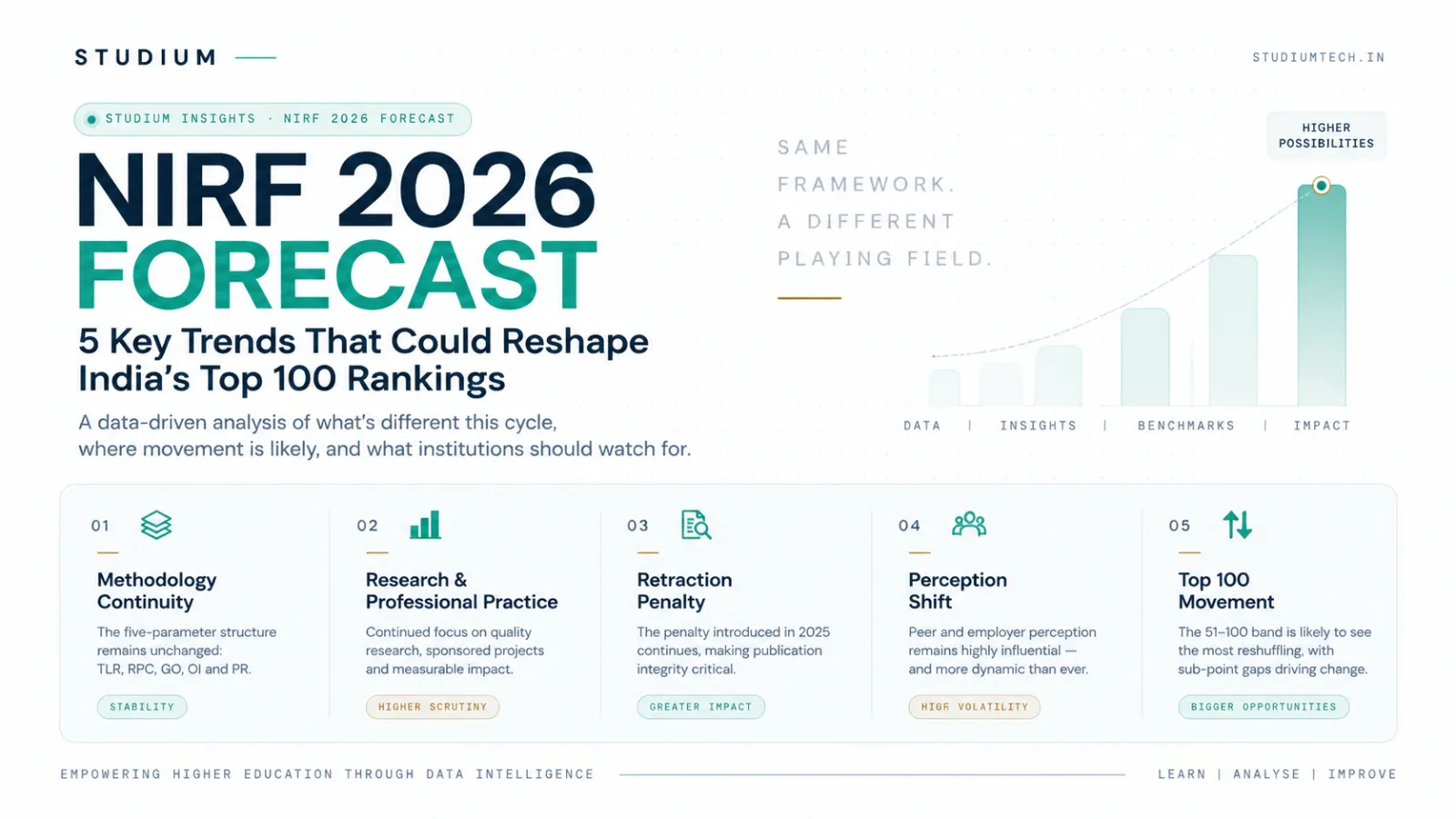
The NIRF 2026 cycle has already moved through most of its process: the Data Capturing System opened on January 6 and closed on March 16, 2026, after an extension, and the portal has made publication and patent data available for institutions to verify. What hasn't happened yet is the release itself — and until it does, any list claiming to show "NIRF 2026 rankings" is either speculation or a repackaging of last year's results.
What we can do usefully, in the meantime, is look at what's structurally different about this cycle compared to 2025, and where that's likely to create the most movement across the Top 100.
What We Know for Certain About This Cycle
A few things are confirmed, not projected:
- The five-parameter structure hasn't changed. TLR, RPC, GO, OI and PR remain weighted at 30/30/20/10/10 respectively for the Overall and University categories, continuing a pattern that has held since the framework's early years.
- The retraction penalty introduced in 2025 continues. Institutions lose score for retracted publications, applied specifically to the Overall, Engineering, Universities and Research Institutions categories.
- Self-citation exclusion, introduced in 2024, continues. Institutional self-citations are stripped out of research-output calculations, which was already a meaningful correction for institutions that had been inflating citation counts internally.
- The Sustainable Development Goals category, added in 2025, continues into this cycle as an additional lens rather than a replacement for the core five parameters.
None of this is new for 2026 specifically — it's the continuation of 2025's changes into a second cycle, which matters because a one-off penalty is different from an established one. Institutions that treated the retraction penalty as a one-time fluke in 2025 and didn't correct their publication practices are the ones most exposed this time.
Where Movement Is Most Likely: The 51–100 Band, Again
Based on the pattern seen in 2025 — where institutions ranked 51–100 showed the fastest research growth of any band, even faster than the Top 25 — this is the range where a second consecutive cycle of the same rules could produce the most visible reshuffling. Institutions in this band that responded to the 2025 changes by tightening their publication practices and pushing sponsored research have had a full cycle to show it. Institutions that didn't may find that standing still, in a system where consecutive rank gaps are often under half a point, functions as a decline.
This is exactly the kind of movement that's hard to eyeball and easy to model. Studium's NIRF Forecast is built for this specific situation — projecting where an institution's parameter scores are likely to land based on its own data trajectory, rather than waiting for the release to find out.
The Retraction Penalty Enters Its Second Year — And That's the Real Variable
A single-cycle penalty tests whether institutions notice a rule. A second consecutive cycle tests whether they've actually changed behavior. Institutions with historically high research output but also higher retraction exposure are the ones to watch here — not because they'll necessarily lose ground, but because the penalty is now compounding against any institution that hasn't audited its own publication pipeline since the rule was introduced.
For an institution unsure where it stands on this specific risk, this is worth checking directly rather than assuming last year's RPC score is a safe baseline for this year.
Perception Remains the Wildcard, Especially Near the Top 50
Perception is collected fresh each cycle and has shown the ability to move fast in response to visible institutional performance — BITS Pilani's jump from rank 19 to rank 7 in the 2025 cycle, driven partly by a perception score that more than doubled, is the clearest recent example. Nothing about the 2026 methodology changes how perception is collected, but a full year of visible movement — new research output, new partnerships, media coverage of ranking improvements — feeds directly into how peers and employers score an institution when the next feedback cycle runs. Institutions that made real, visible gains in 2025 have a reasonable case for a perception bump this cycle; institutions that didn't shouldn't expect one just because time has passed.
What Studium's Forecast Model Tracks
Rather than guessing at where the Top 100 will land, Studium's approach is to model an institution's own parameter trajectory against the rules that are actually in effect for this cycle — not last year's rules, and not speculation about what might change next. That means factoring in the continuing retraction penalty, the stabilized SDG category, and the same core weightings, then projecting where an institution's TLR, RPC, GO, OI and PR scores are headed relative to its peer set.
NIRF Ranking Analysis shows where an institution currently stands against Top 50 and Top 100 benchmarks. NIRF Forecast projects where that trajectory leads before the official release. NIRF Simulator tests what a specific change — closing a publication-integrity gap, adding sponsored research, improving placement documentation — would do to the projected score.
What Institutions Should Do Before the Release
- Audit publication integrity now, not after the release. With the retraction penalty in its second year, this is no longer a new risk to explain away.
- Revisit last year's perception trajectory. If your institution made genuine, visible gains in 2025, that's a reasonable basis for expecting some perception movement — not a guarantee.
- Don't assume standing still is neutral. In the 51–100 band specifically, flat performance in a system where peers are actively closing sub-point gaps functions as a relative decline.
- Treat this as data to verify, not predict. The only confirmed source for NIRF 2026 results will be the official release on nirfindia.org — everything above is a structural read on what's already known, not a claim about final ranks.
Figures referenced are drawn from the official NIRF portal (nirfindia.org), the Ministry of Education's India Rankings 2025 report, and published news coverage of the 2026 data-submission cycle as of September 2026. The NIRF 2026 release date has not been officially announced at the time of writing; verify current status directly on nirfindia.org before making institutional decisions based on any forecast, including this one.
0
Discussion
0 comments