
The Work That Begins After Evaluation
By Studium Tech Pvt Ltd · 24 Aug 2026 · 44 views · edited 24 Aug 2026
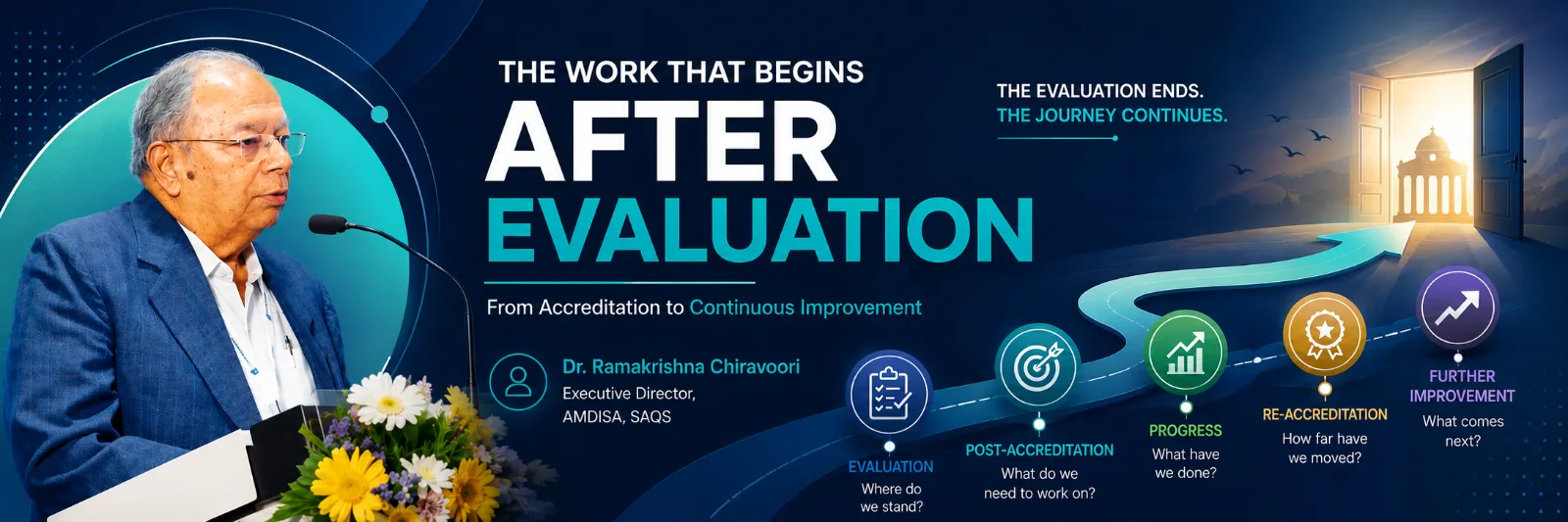
An accreditation decision can tell us where an institution stands. The more difficult question is what the institution does next.
At the Beyond Accreditation Bangalore Summit, Dr. Ramakrishna Chiravoori, Executive Director, AMDISA, SAQS, offered a focused perspective on what lies beyond the accreditation process.
His message was centred on continuity.
Accreditation should not be treated as the end of institutional reflection. The work continues through post-accreditation management, further evidence, progress reporting and re-accreditation.
An Institution Does Not Stand Still
Documentation captures an institution at a particular moment.
But institutions evolve.
As Dr. Chiravoori explained, documentation that may be sufficient at one point cannot simply remain unchanged several years later. It needs to be supported by further data.
This makes the passage of time an important part of quality assurance.
The question becomes:
How has the institution progressed since its last evaluation?
The Post-Accreditation Period Matters
Within SAQS, the accreditation process extends into the post-accreditation period.
For institutions receiving five-year accreditation, three objectives are identified for the institution to pursue.
A mid-term report is then used to show progress against the expectations identified by the peer review team.
This creates a continuing relationship between evaluation and improvement.
The institution does not simply receive an accreditation decision and move on.
It continues working against identified expectations.
Re-accreditation Keeps the Conversation Moving
Dr. Chiravoori also addressed the role of re-accreditation.
If an institution has already been accredited, it may seem reasonable to ask why another accreditation cycle is necessary.
The answer lies in the opportunity for further thinking and improvement.
Re-accreditation also allows an institution's progress to be considered by an independent body.
In this sense, the process creates another moment for the institution to examine where it has reached and what it needs to work on next.
Different Levels, Different Requirements
The session also highlighted that the post-accreditation process can differ depending on the accreditation outcome.
Where accreditation is based on a reduced set of standards, institutions have more intensive post-accreditation requirements.
They submit annual reports, which are reviewed by members of the peer review team.
These reports examine progress against the expectations established during the peer review.
The institution receives the review and continues its work accordingly.
Beyond Accreditation Is a Choice
Perhaps one of the most important points from Dr. Chiravoori's session is that going beyond accreditation requires institutional involvement.
It is not simply something that happens automatically after an accreditation decision.
Institutions differ in their enthusiasm and level of participation.
The responsibility ultimately depends on the institution's:
Effort
Interest
Involvement
and its response to a competitive and dynamic environment.
The process provides a structure.
The institution has to choose how actively it uses it.
From Evaluation to Continuity
The session can be understood through a simple progression:
Evaluation
Where do we stand?
↓
Post-Accreditation
What do we need to work on?
↓
Progress
What have we done?
↓
Re-accreditation
How far have we moved?
↓
Further Improvement
What comes next?
This is the continuing journey that sits beyond the accreditation decision.
The Point Is Not the Certificate
The conversation around accreditation can easily become centred on the final outcome.
But Dr. Chiravoori's perspective shifts attention towards what happens after that outcome.
A certificate represents a point in time.
The institution's progress represents what happens between one point and the next.
That progress requires continued evidence, continued effort and continued involvement.
Beyond Accreditation
The phrase “Beyond Accreditation” therefore becomes a question of continuity.
Not:
Did we complete accreditation?
But:
What did we do after it?
Not:
Did we receive the decision?
But:
How did we respond to it?
Not:
Do we have documentation?
But:
How has the institution progressed over time?
Dr. Ramakrishna Chiravoori's session reminds us that the accreditation process may have an evaluation point, but the institution's journey does not stop there.
The evaluation ends. The journey continues.
1
Discussion
0 comments