
What is One Nation One Data (ONOD)? A Complete Guide to Higher Education Data Governance, Accreditation & HEQF
By Aashish Khandkar · 10 Aug 2026 · 18 views · edited 10 Aug 2026
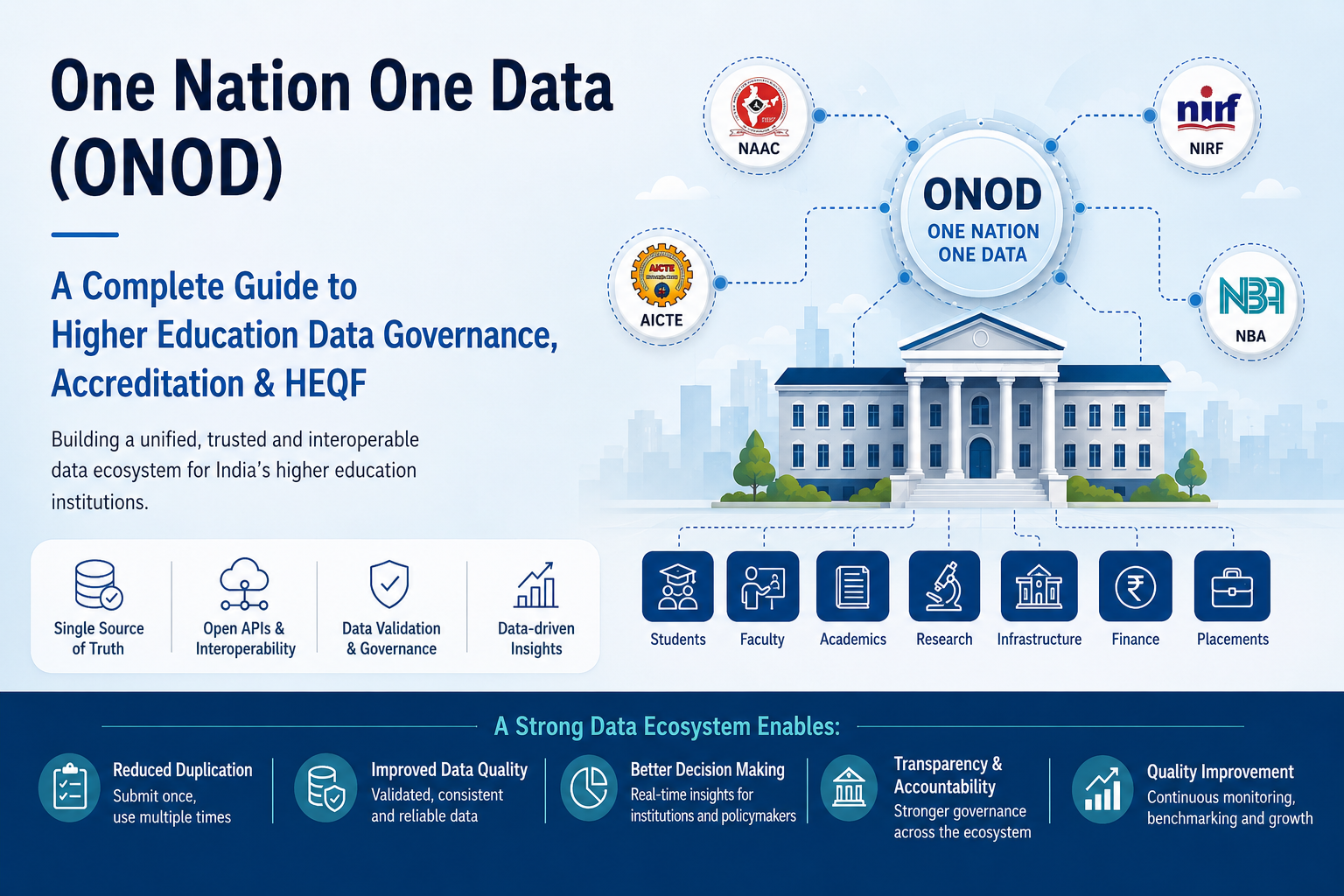
One Nation One Data (ONOD): Transforming Data Governance in Higher Education
One Nation One Data (ONOD): Transforming Data Governance in Higher Education
India’s higher education institutions generate vast amounts of data every year — from student enrolment and faculty strength to research, placements, infrastructure and finances.
However, much of this information is repeatedly collected and submitted to different agencies and frameworks. One Nation One Data (ONOD) aims to address this challenge by creating a more unified and interoperable higher education data ecosystem.
The ONOD platform uses the AISHE code to connect institutions with Open APIs and facilitate data exchange across stakeholders such as NAAC, AICTE, NIRF and NBA.
Why Does Higher Education Need One Nation One Data?
Institutions often maintain the same information across multiple departments and spreadsheets.
For example, faculty data may separately exist with HR, departments, IQAC, NIRF teams and accreditation teams.
This can lead to:
- Duplicate data collection
- Different versions of the same information
- Manual errors
- Inconsistent reporting
- Increased administrative workload
ONOD aims to move institutions towards a single, reliable source of institutional data that can be reused across different requirements. Government reform proposals envision common data supporting agencies including AISHE, UGC, AICTE, NAAC, NBA and NIRF.
Key Components of ONOD
Standardized Data
Institutions need consistent definitions, formulas and reporting periods for important metrics.
Data Validation
Data should be checked for accuracy, completeness and consistency before being used for reporting or assessment.
Open APIs
APIs allow different systems to exchange information, reducing the need for institutions to repeatedly enter the same data.
Single Source of Truth
A centralized institutional dataset can become the foundation for reporting, benchmarking and decision-making.
ONOD and Accreditation
Accreditation depends heavily on institutional evidence across areas such as teaching, research, faculty, student outcomes, infrastructure and governance.
A unified data ecosystem can help institutions move from:
Collect → Compile → Submit
to:
Capture → Validate → Monitor → Improve
This supports a more continuous approach to quality assurance rather than treating accreditation as a periodic submission exercise.
ONOD and NIRF
NIRF also relies on extensive institutional data across Teaching, Learning & Resources, Research & Professional Practice, Graduation Outcomes and Outreach & Inclusivity.
With better data governance, institutions can use this information for more than annual submissions.
They can monitor:
- Year-on-year performance
- Peer benchmarks
- Parameter-level gaps
- Institutional strengths and weaknesses
This turns NIRF data into a strategic institutional resource rather than simply a ranking requirement.
The Role of AI
Reliable and structured institutional data also creates opportunities for AI-powered analysis.
AI can help institutions:
- Detect data inconsistencies
- Identify performance trends
- Benchmark against peers
- Find gaps
- Generate actionable insights
For example, an AI system could identify a decline in research output per faculty member even when overall faculty strength is increasing.
This allows institutional leaders to move from simply viewing data to understanding what the data means.
What Does ONOD Mean for HEQF?
For Studium's Higher Education Quality Framework (HEQF), the shift towards unified institutional data creates an opportunity to make quality improvement more continuous and evidence-driven.
HEQF can help institutions connect:
Institutional Data → Quality Indicators → Benchmarking → Gap Analysis → Action → Improvement
Instead of asking only:
“Where does the institution stand?”
a data-driven quality framework can help answer:
“Why is it performing at this level, where are the gaps, and what should improve next?”
The Future of Higher Education Data
One Nation One Data represents a broader shift:
Fragmented data → Unified data
Repeated submissions → Reusable data
Manual reporting → Interoperable systems
Compliance → Continuous improvement
The future of higher education quality will depend not only on how much data institutions collect, but on whether that data is accurate, consistent, verifiable and actionable.
For institutions, the goal is simple:
Data → Evidence → Insight → Action → Improvement
And that is where ONOD can become more than a reporting initiative — it can become a foundation for a more transparent, data-driven and continuously improving higher education ecosystem.
0
Discussion
0 comments