
What Is Outcome-Based Education (OBE)? A Complete Guide to OBE Framework, Implementation & AI-Powered OBE Software
By Studium Tech Pvt Ltd · 8 Aug 2026 · 36 views
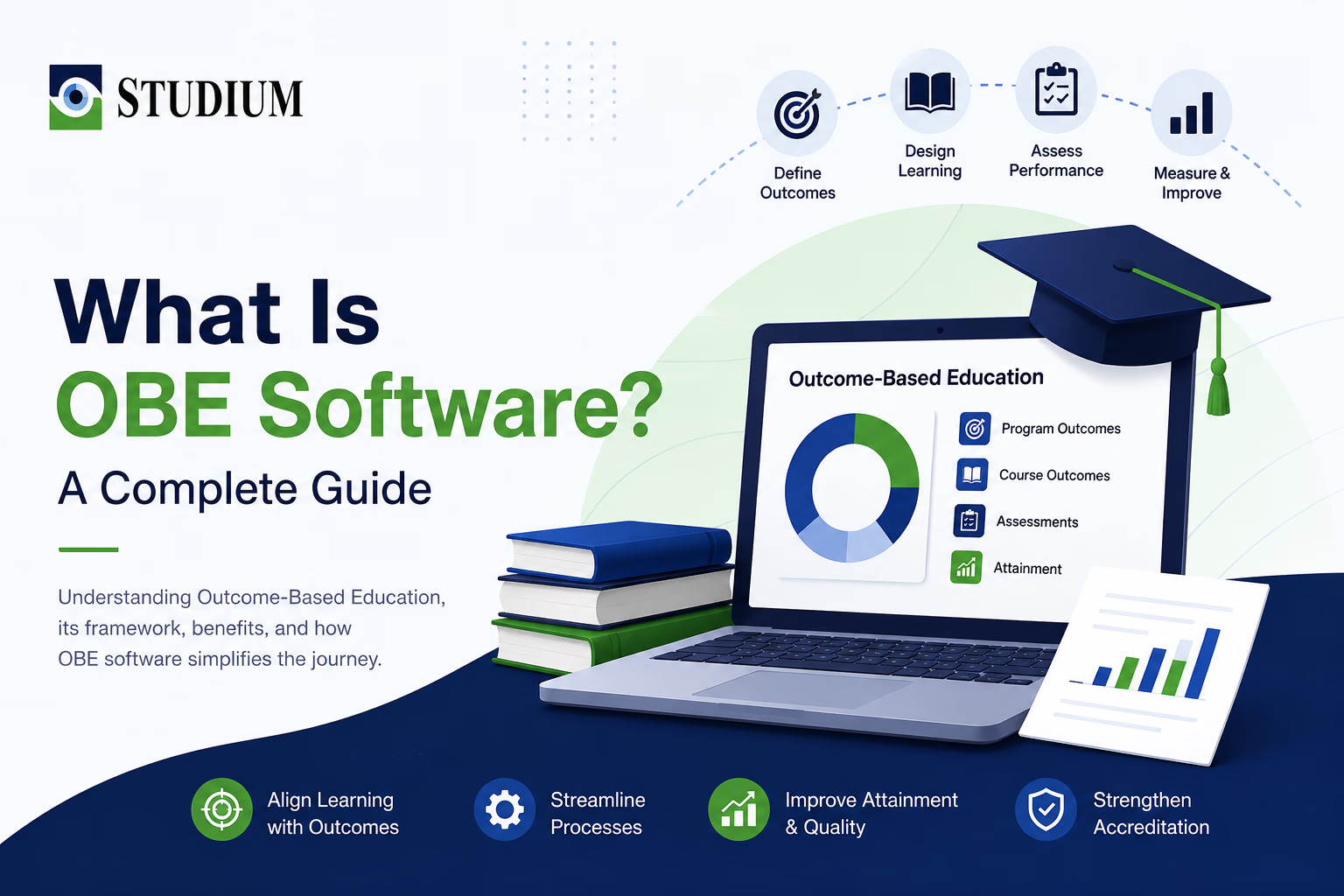
Instead of focusing only on syllabus completion or classroom delivery, OBE focuses on:
- What students should know
- What competencies students should develop
- What learners should be able to perform after completing a course or program
In OBE:
- Curriculum
- Pedagogy
- Assessments
- Attainment systems are all aligned towards achieving measurable learning outcomes.
The philosophy of OBE shifts education from:
“What was taught?”
to:
“What was actually learned?”
Key Components of Outcome-Based Education
A strong OBE framework is built using multiple academic components that align together systematically.
Vision & Mission
These define the broader intent and academic philosophy of the institution.
Program Educational Objectives (PEOs)
PEOs define what graduates are expected to achieve a few years after completing the program.
Program Outcomes (POs)
POs define the competencies and skills students should possess at the time of graduation.
Program Specific Outcomes (PSOs)
PSOs define domain-specific outcomes related to a particular program or specialization.
Course Outcomes (COs)
COs define what students are expected to learn from a specific course.
Bloom’s Taxonomy
Bloom’s taxonomy helps define the depth of learning expected from students.
It includes levels such as:
- Remember
- Understand
- Apply
- Analyze
- Evaluate
- Create
Attainment
Attainment measures whether defined outcomes are actually being achieved by learners.
Why Institutions Need OBE Software
As institutions started implementing Outcome-Based Education at scale, the operational complexity of OBE increased significantly.
Faculty members today spend countless hours:
- Writing Course Outcomes (COs)
- Mapping COs with Program Outcomes (POs)
- Calculating attainment
- Preparing accreditation documentation
- Managing spreadsheets and report
As a result, in many institutions, OBE is treated more like a compliance exercise rather than a framework for improving teaching and learning.
This is where OBE software becomes important.
Modern OBE software helps institutions simplify, automate, and strengthen the complete OBE lifecycle — from curriculum alignment and CO design to attainment analysis and continuous improvement.
A modern OBE software platform should not function only as an attainment calculator.
It should support the complete academic intelligence lifecycle.
Why Outcome-Based Education Became Critical in Higher Education
As institutions started implementing Outcome-Based Education at scale, the operational complexity of OBE increased significantly.
Faculty members today spend countless hours:
- Writing Course Outcomes (COs)
- Mapping COs with Program Outcomes (POs)
- Calculating attainment
- Preparing accreditation
- documentation
- Managing spreadsheets and reports
As a result, in many institutions, OBE is treated more like a compliance exercise rather than a framework for improving teaching and learning.
This is where OBE software becomes important.
Modern OBE software helps institutions simplify, automate, and strengthen the complete OBE lifecycle — from curriculum alignment and CO design to attainment analysis and continuous improvement.
A modern OBE software platform should not function only as an attainment calculator.
It should support the complete academic intelligence lifecycle.
Why Outcome-Based Education Became Critical in Higher Education
One of the major reasons behind the rapid adoption of Outcome-Based Education in India was the signing of the Washington Accord.
The Washington Accord is an international agreement between accreditation bodies that recognizes the equivalence of engineering education standards across member countries.
With India becoming a permanent signatory through NBA, institutions were expected to move beyond traditional content-driven teaching models and demonstrate measurable student outcomes.
This fundamentally changed the way institutions approached:
- Curriculum design
- Teaching-learning processes
- Assessment systems
- Academic quality assurance
The focus shifted from:
“What was taught?”
to:
“What did the student actually learn?"
The National Education Policy (NEP) 2020 further accelerated this transformation by emphasizing:
- Competency-based learning
- Experiential learning
- Critical thinking
- Multidisciplinary education
- Skill-oriented teaching
- Innovation and creativity
NEP 2020 strongly encourages institutions to move away from rote learning and build learning environments that focus on application, analysis, problem-solving, and real-world readiness.
Outcome-Based Education naturally aligns with this philosophy because it focuses on defining what learners should be able to achieve at the end of a course or program.
As a result, OBE is now deeply connected with:
- NBA accreditation
- NAAC accreditation
- AACSB
- Assurance of Learning (AOL)
- International accreditation frameworks
- Employability-focused education
- NEP 2020 transformation goals
Modern accreditation systems no longer evaluate institutions only on infrastructure or documentation.
They increasingly ask:
- What are students learning?
- How are institutions measuring learning?
- What improvements are being made based on learning outcomes?
This has made OBE one of the central pillars of academic quality assurance in higher education.
What Happens When Faculty Teach with OBE at the Center?
Traditional teaching often focuses on:
- Syllabus completion
- Classroom delivery E
- xamination preparation
In such systems:
- Teaching becomes content-driven
- Assessments become memory-oriented
- Learning outcomes remain unclear
However, when faculty design courses with OBE at the center, the entire teaching-learning process changes.
Example: Traditional Teaching Approach
Consider a faculty teaching “Introduction to Marketing.”
The common approach may look like:
- Complete all 5 units
- Conduct lectures chapter-wise
- Take quizzes and written exams
- Evaluate based on marks
In this model:
- Assessments may not measure actual competencies
- Bloom’s taxonomy may not be considered
- Students may memorize concepts without application
Example: OBE-Centered Teaching Approach
Now consider the same course taught using Outcome-Based Education principles.
Before teaching begins,
the faculty:
- Identifies competencies students should gain
- Defines measurable Course Outcomes
- Decides Bloom’s taxonomy levels
- Aligns pedagogy accordingly
- Designs assessments intentionally
Example:
If the expected outcome is:
“Students should be able to analyze market segmentation strategies”
Then:
- Teaching may include case studies
- Industry examples
- Research-based assignments
- Analytical discussions
The assessments may involve:
- Market analysis tasks
- Segmentation exercises
- Live business scenarios
- Presentation-based evaluation
This transforms:
- Teaching
- Assessment
- Student engagement
- Academic quality
OBE therefore changes the question from:
“Did I complete the syllabus?”
to:
“Did students achieve meaningful learning outcomes?”
The Problem with Traditional OBE Systems
Over the last few years, institutions have started implementing OBE aggressively. However, many institutions still manage OBE using:
- Excel sheets
- Manual documentation
- Decentralized processes
- Static attainment files
This creates multiple challenges.
1. OBE Becomes a Post-Facto Activity
In many institutions, OBE implementation starts only after teaching is completed.
Faculty members rush to:
- Create COs
- Complete mappings
- Calculate attainment
- Generate reports
As a result, OBE becomes a documentation process instead of a learning improvement system.
2. Random CO-PO Mapping
Because of workload and lack of clarity, CO-PO mapping often becomes mechanical.
Many courses are mapped with too many program outcomes without meaningful academic alignment.
This reduces:
- Depth of learning
- Clarity of curriculum intent
- Focus of the course
3. Incorrect Bloom’s Taxonomy Alignment
Another common issue is improper alignment between:
- Learning outcomes
- Bloom’s taxonomy
- Assessment patterns
For example: Institutions often try to evaluate “Create” or “Evaluate” Bloom’s levels using quizzes or basic written exams.
This leads to poor measurement of higher-order thinking skills.
4. Excessive Documentation Burden
Faculty members spend significant time managing:
- Excel sheets
- Attainment reports
- Mapping documents
- Assessment records
This reduces time available for:
- Teaching innovation
- Research
- Curriculum enhancement
What Should a Modern OBE Software Do?
A modern OBE software platform should not function only as an attainment calculator.
It should support the complete academic intelligence lifecycle.
The OBE Intelligence Framework
A strong OBE system should ideally support the following stages:
1. Vision & Mission Alignment
OBE should align with institutional intent.
For example:
- An entrepreneurship-focused institution may design outcomes differently from a placement-focused institution.
- Curriculum, pedagogy, and assessments should reflect the institution’s academic philosophy.
2. Competency Identification
Before writing COs, faculty should identify:
- Core competencies
- Skills expected from learners
- Depth of learning required
This helps define the real scope of the course.
3. CO Design & Quality Analysis
Good Course Outcomes should:
- Be measurable
- Be aligned with Bloom’s taxonomy
- Reflect competencies
- Connect with program outcomes
A strong OBE system should help faculty evaluate the quality of COs instead of merely storing them.
4. Intelligent CO-PO Mapping
Mapping should be meaningful, focused, and academically justified. Institutions should avoid “dense mapping” where every CO is mapped with too many POs.
Instead, focused and high-strength mappings often lead to better academic clarity.
5. Pedagogy Planning
One of the biggest gaps in traditional OBE implementation is pedagogy alignment.
OBE should influence:
- Teaching methods
- Case study selection
- Research-based assignments
- Assessment design
This is where modern platforms can help faculty identify:
- Relevant research papers
- Case studies
- Teaching resources
- Innovative pedagogy approaches
6. Assessment Alignment
Assessments should reflect:
- Learning intent
- Bloom’s taxonomy level
- Competency expectations
Different Bloom’s levels require different modes of assessment.
For example:
- Apply → Viva / practical case analysis
- Analyze → Analytical assignments
- Create → Projects / business plans / design activities
7. Attainment & Continuous Improvement
Attainment should not be viewed only as a number.
A meaningful OBE system should help institutions:
- Identify weak learners
- Identify curriculum gaps
- Analyze teaching effectiveness
- Improve future course delivery
This is where OBE transitions from compliance to academic intelligence.
How AI is Transforming OBE Software
The next generation of OBE software is now using Artificial Intelligence to improve academic decision making.
Instead of only storing data, AI-powered OBE systems can now:
- Analyze syllabus and competencies
- Suggest Course Outcomes
- Evaluate CO quality
- Recommend CO-PO mappings
- Support pedagogy planning
- Suggest research papers and case studies
- Identify learning gaps
- Generate improvement insights
This significantly reduces manual effort while improving the quality of implementation.
Introducing Smart OBE
Smart OBE by Studium is India’s first AI-powered Outcome-Based Education platform.
Unlike traditional OBE tools that function mainly as attainment calculators, Smart OBE focuses on the complete academic lifecycle.
The platform helps institutions:
- Analyze syllabus and competencies
- Create better COs
- Perform intelligent CO-PO mapping
- Improve pedagogy using the Educator’s Toolkit
- Align assessments with Bloom’s taxonomy
- Conduct attainment analysis
- Generate academic insights and improvement recommendations
The goal is simple: Move institutions from OBE compliance to academic intelligence.
Benefits of Using OBE Software
For Faculty
- Reduced documentation burden
- Faster CO-PO mapping
- Better pedagogy planning
- Simplified attainment calculations
For IQAC Teams
- Standardized implementation
- Easier monitoring
- Centralized reporting
- Accreditation readiness
For Institutional Leadership
- Better academic visibility
- Data-driven decision-making
- Improved outcome tracking
- Stronger accreditation preparedness
OBE Software and Accreditation
OBE software now plays a critical role in:
Institutions increasingly require platforms that can support:
- Outcome measurement
- Documentation
- Continuous improvement
- Data-driven academic processes
Final Thoughts
OBE was never meant to be just a compliance requirement.
Its real purpose is to improve:
- Teaching quality
- Student learning
- Curriculum effectiveness
- Academic decision-making
Institutions that continue to manage OBE through fragmented spreadsheets and post-facto documentation will increasingly struggle with scalability and quality.
The future of Outcome-Based Education lies in intelligent, integrated, and AI-driven systems that support the complete learning lifecycle.
Modern OBE software is no longer just about attainment calculation.
It is about building smarter academic systems.
1
Discussion
0 comments