
Which NIRF Parameter Best Separates Top 25, Top 50 and Top 100?
By Studium Tech Pvt Ltd · 22 Sept 2026 · 2 views · edited 22 Sept 2026
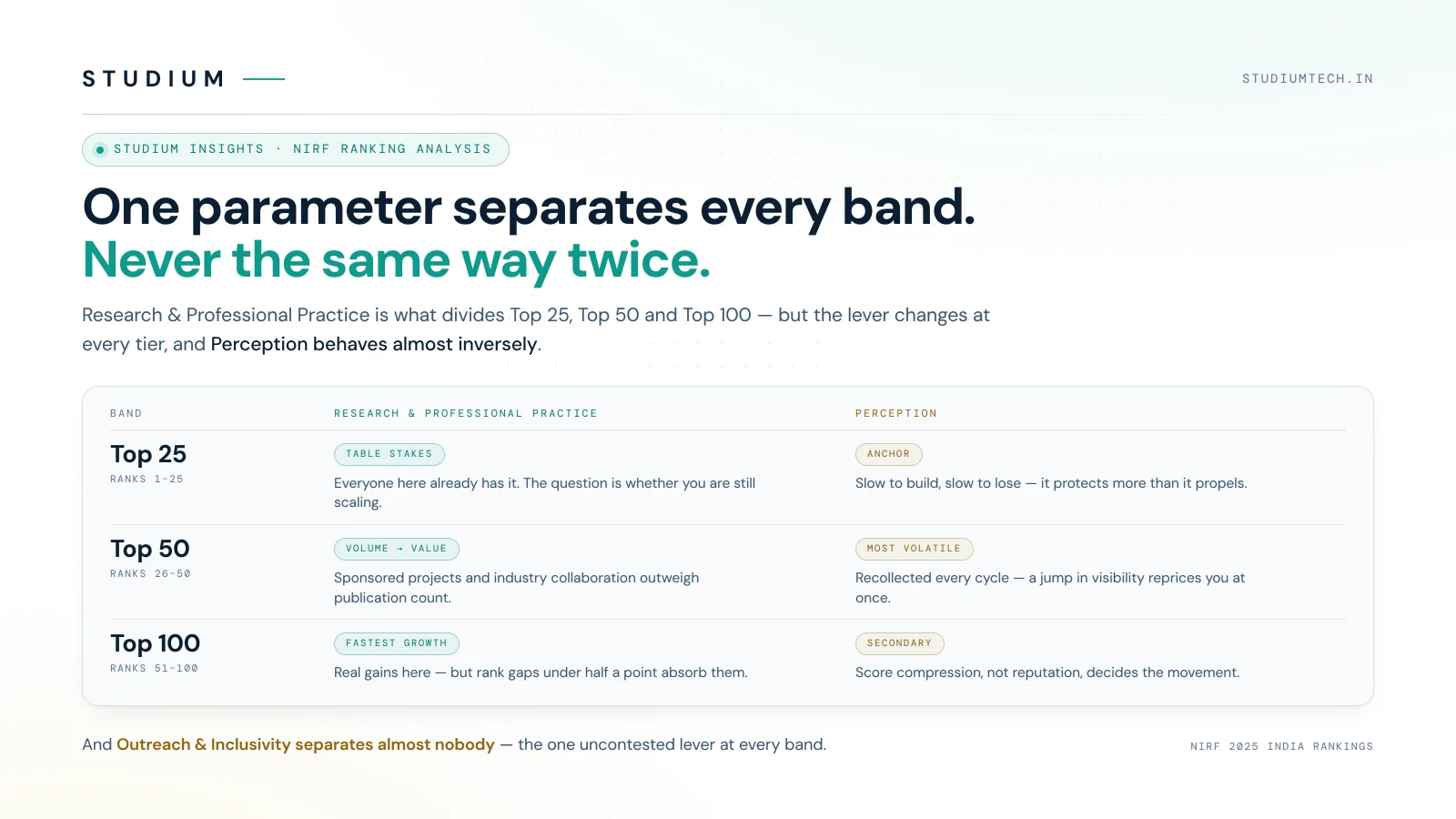
Research and Professional Practice (RPC) is the parameter that separates all three NIRF band - Top 25, Top 50, and Top 100 - but it doesn't separate them the same way each time. Near the top, it's about sustained research volume. In the middle, it's about the quality of collaborations.
Near the edge of the Top 100, it's about which institutions are growing research output fastest.
Perception is the secondary factor, and it behaves almost the opposite way: it matters least at the
very top and most in the middle, where a single good year can move an institution several places.
Top 25: RPC Is Already a Baseline, Not a Differentiator on Its Own
Inside the Top 25, nearly every institution already has a strong research profile - this is where IITs, IISc, and the leading centrally funded universities cluster, and research output at this level is less about whether an institution does research and more about how much and how consistently.
Between 2018 and 2023, institutions in this band roughly doubled their research projects and grew research funding by more than 50 percent, which tells you the real competition here isn't “does this institution publish” but “is this institution still scaling.”
What actually moves rank within the Top 25 is closer to Perception than RPC. Institutions here carry a meaningful reputational premium that's slow to build and slow to lose - IITs specifically carry an estimated 15–20 point Perception advantage over peer institutions regardless of short-term fluctuation. At this level, Perception behaves like an anchor: it rarely swings the rank dramatically, but it quietly protects institutions from being overtaken by fast-improving challengers just below them.
Top 25 to Top 50: Collaboration Quality Overtakes Raw Output
Once you move past the Top 25, the story changes. Institutions ranked roughly 26–50 aren't competing on research volume the way the top tier does - they're gaining ground through high-value collaborations: sponsored projects, industry partnerships, and consultancy work that carries more weight per project than sheer publication count. This is a meaningfully different
strategy than what works in the Top 25, and it's why institutions sometimes plateau here despite genuinely improving - they're still optimising for volume when the band above them is optimising for value.
This is also where Perception becomes the most volatile parameter in the entire framework. Because Perception is collected fresh each cycle from peers and employers, a real jump in research visibility can translate into a large score change almost immediately. BITS Pilani's move from rank 19 to rank 7 in a single year - driven partly by a Perception score that more than doubled, from under 20 to just over 49 - is the clearest evidence that this band is where reputation and substance move together fastest.
Top 50 to Top 100: This Is Where RPC Growth Is Fastest — And Least Rewarded Yet
Counterintuitively, institutions ranked 51–100 show the fastest research growth of any band, faster than the Top 25 and faster than the 26–50 group. That's not a contradiction - it reflects a lower starting base with real momentum. The problem is that this band also sits in the tightest score compression zone in the entire ranking system. Consecutive rank gaps here are frequently under
half a point, meaning a real, measurable improvement in RPC often produces a smaller rank jump than the same effort would produce at the top.
This is precisely where Studium’s NIRF Ranking Analysis earns its keep - an institution in this band needs to know not just that its RPC score is improving, but exactly how that improvement compares to the score gap separating it from the Top 50, because in this range, a 2-point RPC gain can be the difference between rank 95 and rank 70.
Where TLR and OI Fit — And Where They Don't
Teaching, Learning & Resources (TLR) is the other 30%-weighted parameter, but it behaves very differently from RPC as a separator. TLR and RPC are only weakly correlated with each other, which means strong infrastructure doesn't reliably predict strong research output, or vice versa - but it also means TLR tends to move slowly and predictably across all three bands, which makes it
a poor explanation for why one institution overtakes another in a single cycle. It matters, but it doesn't discriminate.
Graduation Outcomes matters most for comprehensive universities without a dominant research identity - it's often the real reason a broad-based university holds a Top 50 position against narrower, research-heavy specialists. But as a general separator across all three bands, it's secondary to RPC.
Outreach and Inclusivity is the one parameter that separates almost nobody - even among the Top 10 institutions, only two scored above 70 on OI in the most recent cycle. That's not because OI doesn't matter; it's because virtually no institution, at any band, has meaningfully optimised for it yet. Which, if you're trying to close a narrow gap, makes it one of the few genuinely uncontested
levers left.
The Practical Takeaway by Band
- Top 25: Protect and slowly build Perception; RPC is table stakes, not a lever.
- Top 25–50: Shift from research volume to research value — sponsored projects and industry collaboration outweigh publication count.
- Top 50–100: RPC growth is real and fast here, but score compression means every point needs to be tracked precisely against Top 50 benchmarks to know if it's actually closing the gap.
All bands: OI is under-optimised everywhere, making it a low-competition way to gain ground
regardless of where an institution currently sits.Institutions that treat "improve the NIRF score" as one goal tend to move slowly. Institutions that know which parameter separates their specific band — and benchmark against it directly with NIRF Ranking Analysis or model the next cycle with NIRF Forecast — tend to move faster, because they're not guessing which lever to pull first.
Figures referenced are drawn from the official NIRF 2025 India Rankings (Ministry of Education, nirfindia.org) and publicly available third-party analyses of the 2025 cycle. NIRF methodology and scores are reviewed and revised periodically; verify current figures on the official NIRF portal before institutional planning decisions. Product links above use
placeholder Studium URLs and should be updated to live page addresses before publishing
0
Discussion
0 comments