
Why NIRF Only Counts Scopus & Web of Science Publications — And What It Means for You
By Studium Tech Pvt Ltd · 8 Aug 2026 · 187 views · edited 24 Aug 2026
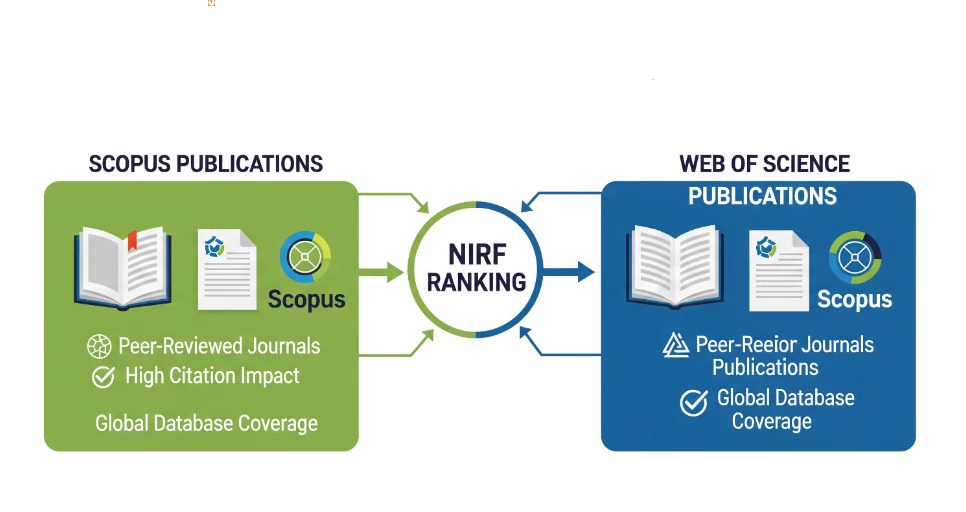
1. What NIRF Actually Measures in Research
Under the NIRF framework, Research and Professional Practice (RP) holds significant weight, especially for universities and engineering institutions. This category includes:
- Number of publications (last 3 years)
- Number of citations
- Quality of journals
- IPR and patents filed
- Footprint of projects and professional practice
But here’s the critical catch: only publications and citations indexed in Scopus and Web of Science are considered.
Source: NIRF official frameworks (2024), reports, and category-wise documentation guidelines.
2. Why Only Scopus and Web of Science?
a. Global Recognition & Credibility
Scopus (by Elsevier) and Web of Science (by Clarivate) are globally recognized indexing databases. They apply rigorous quality checks before indexing journals, ensuring that:
- Peer-review processes are robust
- Journals are editorially sound
- Citation metrics are trackable and standardized
b. Citation Validation
These platforms offer rich metadata, citation tracking, and journal-level impact factors that help NIRF validate publication volume and research impact.
c. Prevention of Predatory Publishing
Many unindexed or predatory journals exist, especially in developing markets. By limiting the scope to Scopus and WoS, NIRF aims to curb quantity-driven publishing in low-quality outlets.
3. Key Differences Between Scopus and Web of Science
| Feature | Scopus | Web of Science |
| Publisher | Elsevier | Clarivate |
| Subject Coverage | Broad incl. Social Sciences | Focus on Science and Engineering |
| Citation Depth | Moderate (since 1996) | Deep (since early 1900s) |
| Journal Volume | ~25,000 journals | ~21,000 journals |
| Indexes | SCImago, CiteScore | JCR, Impact Factor |
Both are prestigious, but they have varying subject coverage and journal strength across disciplines.
4. How This Impacts Your NIRF Scores
a. No Indexing = No Score
If your institution publishes heavily in journals not indexed in Scopus or WoS, those publications don’t count in your RP score.
b. Citations Must Be Counted
Citations from Google Scholar, UGC-CARE, or ResearchGate may appear impressive, but they aren’t considered in NIRF calculations.
c. Research Trends Drive Rankings
Top 100 institutions, which dominate NIRF rankings, have consistently high Scopus and WoS publication output. Over 95% of their papers are internationally co-authored, reflecting not just volume but global relevance.
5. Common Myths Institutions Fall For
Myth 1: "UGC-CARE listed journals are good enough."
- Reality: UGC-CARE is useful for regulatory compliance but not for NIRF rankings unless the journal is also in Scopus or WoS.
Myth 2: "Google Scholar citations help our scores."
- Reality: Google Scholar is inclusive but lacks the curated filters of Scopus/WoS.
Myth 3: "Any peer-reviewed journal adds value."
- Reality: Peer-review alone doesn’t ensure visibility. Indexed status matters.
6. Strategic Shifts Institutions Should Make
a. Audit Existing Publications
Use tools like Research360 to:
- Map faculty-wise publications over the past 3 years
- Classify by indexing database (Scopus/WoS vs. others)
- Identify non-contributing journals
b. Align Faculty Publishing Strategy
Encourage publishing in:
- Scopus Q1–Q2 journals (for higher visibility)
- Web of Science core collections
- Interdisciplinary journals with high citation rates
c. Reward Indexed Output
Incentivize Scopus/WoS publications in internal appraisals and promotions. Tie funding proposals to research quality metrics.
7. Accreditation Overlap: NAAC, NBA, and NIRF
Research output is critical not just for NIRF, but also for:
- NAAC: Criterion 3 (Research, Innovation, and Extension)
- NBA: Program Outcomes & Publications
- AACSB: Emphasis on impact-oriented research
Bonus: Institutions using AI-driven platforms like Research360 can:
- Auto-track indexed journals
- Auto-fetch data from ORCID and Google Scholar
- Export SSR/DVV/NIRF-ready reports
8. What If You Publish in Non-Indexed Journals?
While such publications may still be useful for pedagogy or local outreach, they will:
- Not contribute to NIRF ranking
- Possibly dilute citation averages
- Require manual documentation for NAAC with less scoring weight
Recommendation: Prioritize dual-indexed journals (in both Scopus & WoS) where possible.
Conclusion: Publish Smart, Not Just Often
To climb the NIRF ladder, your research publishing strategy must be aligned with visibility, impact, and indexing standards. It’s not just about producing more papers—it’s about producing the right papers.
With Research360, Studium helps institutions:
- Identify publication gaps
- Track department-wise indexing trends
- Plan journal strategies based on NIRF parameters
If your current publishing doesn’t show up in NIRF’s lens, it may not exist at all.
4
Discussion
0 comments