
Times of India · 11 Aug 2026
AISHE’s First NEP Stocktake Shows Patchy Reform Map
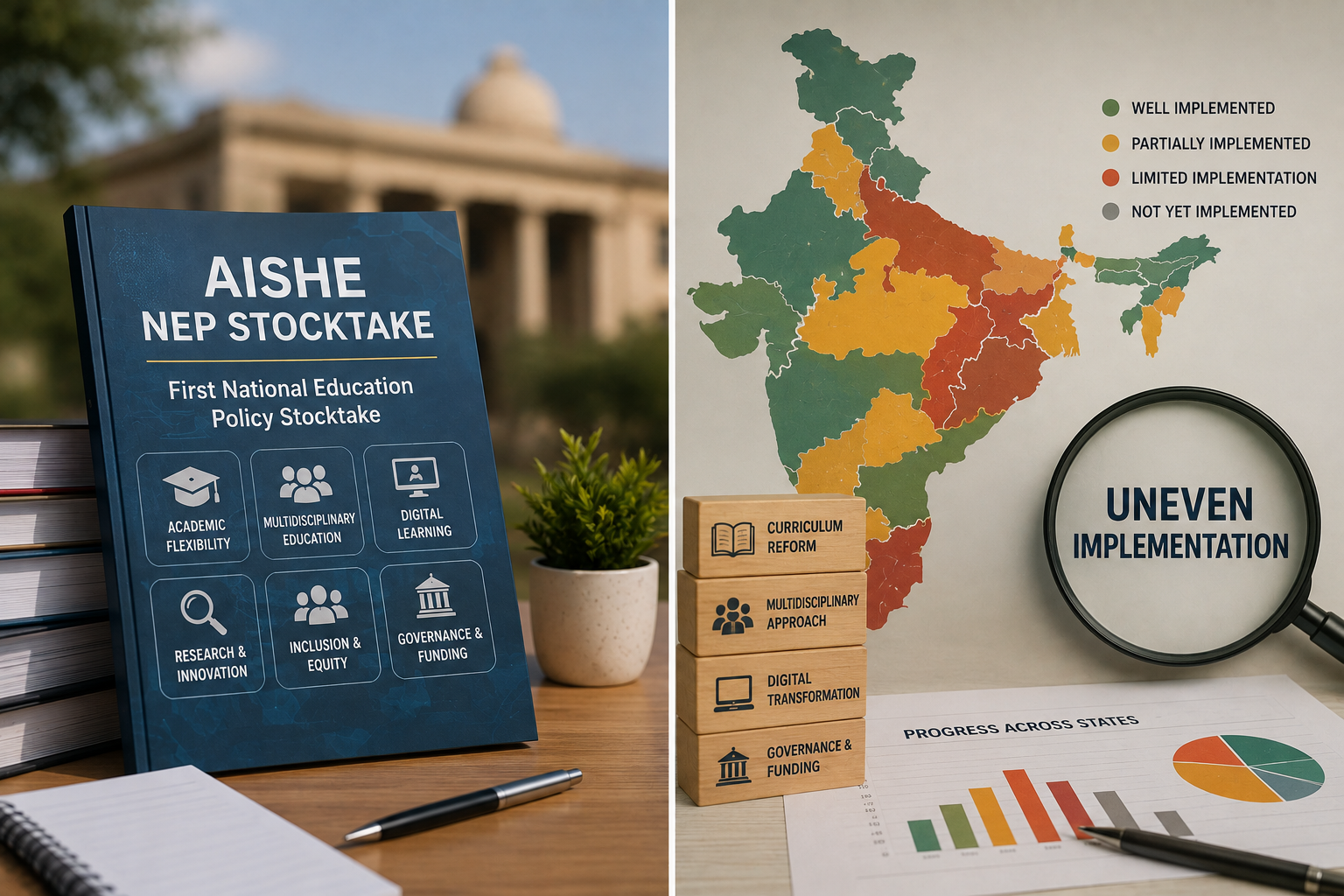
The first dedicated NEP implementation module in the All India Survey on Higher Education (AISHE) has found uneven adoption of National Education Policy 2020 reforms across Indian universities. Of responding institutions, 56% had introduced four-year undergraduate programmes, 49% offered multiple entry and exit, 58% had adopted the National Curriculum and Credit Framework, and 69% were registered on the Academic Bank of Credits. Research structures showed stronger uptake, but industry exposure remained limited, with only 41% reporting Internship Cells and 7% Apprenticeship Cells.
Why it matters
The findings provide one of the clearest early system-level indications of how differently NEP 2020 reforms are progressing across Indian higher education. The relatively strong adoption of structures such as Research and Development Cells and Academic Bank of Credits suggests movement toward the policy's broader objectives, but the lower uptake of four-year degrees, multiple entry and exit, SWAYAM regulations and industry-linked mechanisms points to significant implementation gaps.
For institutions, the stocktake highlights that policy adoption cannot be measured simply by whether a framework has been formally introduced. Effective implementation requires curriculum redesign, administrative capacity, industry partnerships and systems that enable students to actually benefit from greater flexibility. The limited presence of apprenticeship and internship structures is particularly relevant to employability and work-integrated learning. The data also provides policymakers and institutional leaders with a baseline for identifying where implementation support, capacity building and stronger accountability may be required.
Source: Times of India (opens in a new tab)
8