
Press Information Bureau · 11 Aug 2026
EXPANSION OF ACADEMIC ASSISTANCE IN HIGHER EDUCATION
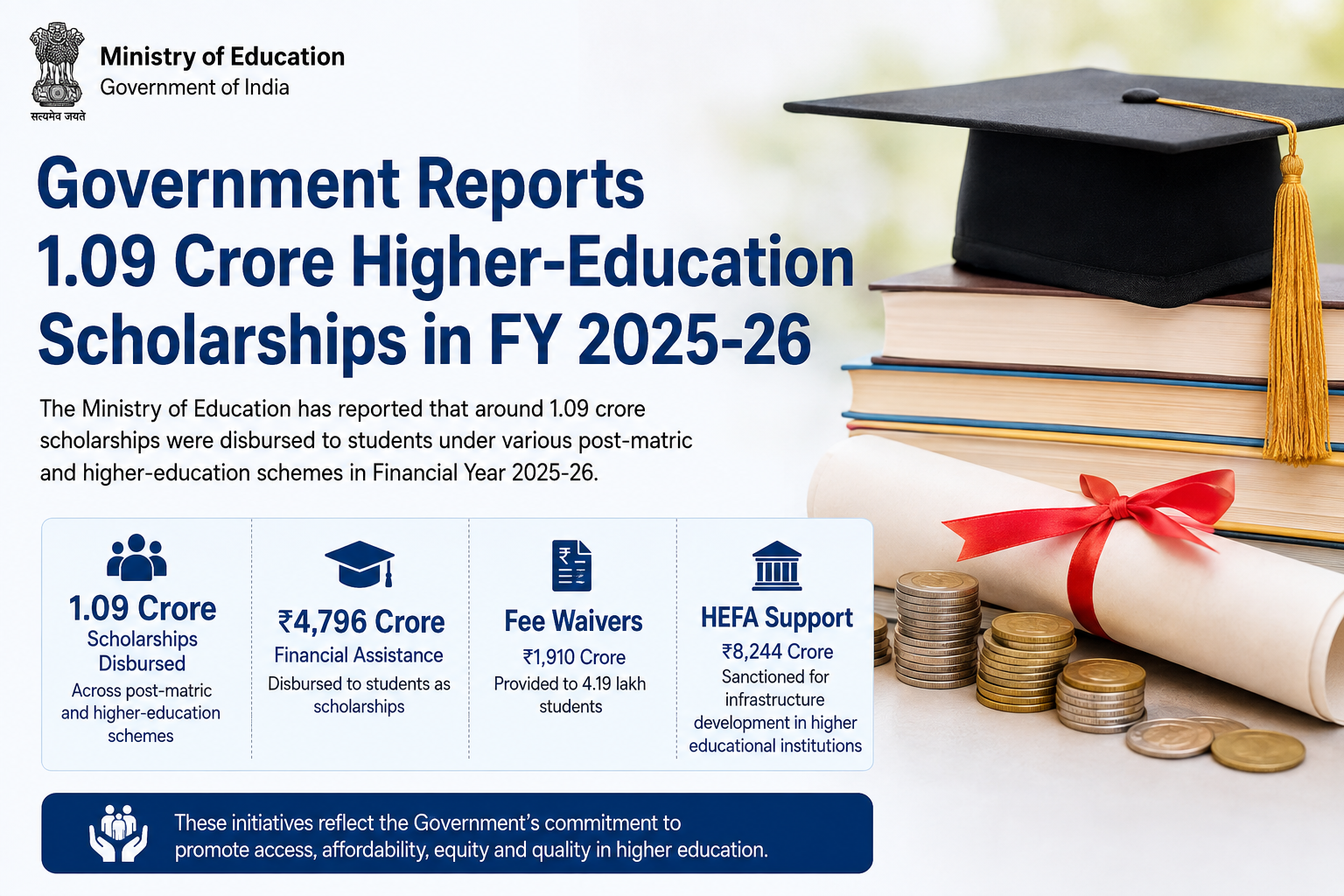
The Central Government reported providing about 1.09 crore scholarships for Post-Matric and Higher Education in FY 2025–26, including around 48 lakh for SC students, 24 lakh for ST students and 36 lakh for OBC, EBC and DNT students. The Ministry also highlighted tuition-fee waivers at IITs and NITs, education-loan support and infrastructure financing. Since 2017, HEFA has disbursed ₹24,977.62 crore in loans to Centrally Funded Institutions for infrastructure development.
Why it matters
The figures provide an important measure of the scale at which affordability and inclusion are being addressed in Indian higher education. Scholarships, tuition waivers and subsidised education finance can reduce financial barriers for students from economically and socially disadvantaged backgrounds, while infrastructure investment—particularly in hostels—can address non-tuition constraints that often determine whether students can actually access higher education.
The wider data also connects financial support with participation: the government reported higher-education GER rising from 23.7 in 2014–15 to 30 in 2023–24, while female GER increased from 22.9 to 31.2. For institutions, the policy direction places greater importance on access, equity, student-support mechanisms and infrastructure planning alongside academic quality. The linkage of the PM-USP interest-subsidy scheme to NAAC-accredited institutions and NBA-accredited technical/professional programmes is particularly relevant because it illustrates how quality assurance and student financial support can intersect within public policy.
Source: Press Information Bureau (opens in a new tab)
8